BasideWT- Whole Home Water Filtration System & Replacement


Whole House UV Water Sterilizer: How It Works and When You Need One
A whole house UV water sterilizer treats water at the point where it enters a building, before it reaches any tap, shower, or appliance. Water passes through a sealed UV chamber, where ultraviolet light exposes bacteria, viruses, and other microorganisms to a disinfection dose. Instead of protecting one faucet, the system protects everything downstream of it.
This makes a whole house UV sterilizer different from a countertop unit or a single under-sink filter. It sits on the main supply line, usually right after the water meter or storage tank, and every fixture in the property draws water that has already passed through it.
For homeowners, villa owners, hotels, schools, and small factories across China, this system-level placement is exactly what makes UV appealing. But placement alone doesn’t answer the harder question: does your property actually need one, and will it perform the way you expect?
What Makes a UV System “Whole House”
The term “whole house” refers to where the UV unit sits in the plumbing, not to the technology itself. The same UV lamp and chamber design used in a small point-of-use unit can also be installed as a whole house system, and the underlying process for how a UV water sterilizer works stays the same regardless of scale. The difference is capacity and position.
A whole house UV sterilizer is sized to handle the total water demand of a building. It sits at the point of entry, sometimes called POE treatment, so treated water flows to every branch of the distribution system. This includes bathrooms, kitchens, laundry connections, and any outdoor taps supplied by the same line.
Because one unit serves the entire property, sizing decisions carry more weight. An undersized system can struggle during periods of high water use, and that directly affects disinfection performance.
How Whole House UV Fits Into a Complete Water System
A UV sterilizer rarely works alone. In most whole house setups, it operates as one stage in a broader treatment sequence rather than the only line of defense.
A typical sequence looks like this:
- Water source – municipal supply, well, borehole, or stored tank
- Pretreatment – sediment filtration, and sometimes additional treatment depending on source water
- Secondary treatment if needed – carbon filtration, softening, or iron and manganese removal
- UV sterilizer – final disinfection barrier before distribution
- Building distribution – water reaches taps, showers, and appliances
Not every property needs every stage. A municipal supply with good clarity may only need basic sediment filtration before UV. A well or tank-fed system with turbidity or mineral issues will usually need more preparation.
This is worth stating clearly: UV does not replace filtration, softening, or sediment removal. It handles microbiological disinfection, and it depends on the water arriving in reasonably clear condition to do that job well. For a deeper look at what UV sterilization can and cannot remove, it helps to understand this boundary before choosing a system.
Where the UV Sterilizer Should Be Positioned
Positioning matters more in a whole house system than in a single-tap setup. The UV unit should sit downstream of any pretreatment stage, so it receives water that is already reasonably clear.
Installing UV before sediment filtration is a common mistake. Cloudy or particle-heavy water can shield microorganisms from UV exposure, reducing disinfection effectiveness even if the lamp itself is working correctly. Placing UV after pretreatment, and as close as practical to the point where water enters the distribution system, gives the unit the best chance to perform consistently.
In buildings with a storage tank, the UV sterilizer is typically installed after the tank rather than before it. This protects water as it leaves storage and moves toward the taps, which is usually more relevant than treating water before it sits in the tank.
Whole House UV vs Point-of-Use UV
Property owners often compare a whole house system against a smaller point-of-use unit installed under a single sink. Both use the same core technology, but they solve different problems.
| Factor | Whole House UV System | Point-of-Use UV System |
|---|---|---|
| Treatment location | Main supply line, point of entry | Individual outlet or appliance |
| Water coverage | All fixtures in the property | One tap or connection |
| Typical application | Property-wide disinfection | Localized drinking water treatment |
| Flow requirement | Sized for total building demand | Sized for a single point demand |
| System planning | Requires careful sizing and pretreatment review | Generally simpler to plan and install |
| Common users | Villas, hotels, schools, small factories | Apartments, single kitchen taps, offices |
Neither option is universally better. A property with one main drinking water concern and no other water quality issues may be well served by a point-of-use unit. A property where microbial risk applies across the whole supply, such as a rural home on well water or a hotel with multiple bathrooms, is a stronger fit for a whole house system.
When Do You Actually Need a Whole House UV System?
This is the question most buyers are really asking, and the honest answer depends on the source water and how the property uses it.
A whole house UV system tends to make practical sense when:
- The property relies on a private well, borehole, or other untreated source with microbiological risk
- Water passes through a storage tank before reaching the taps
- The building has multiple bathrooms, kitchens, or guest rooms sharing one supply line
- Source water quality varies seasonally or after heavy rainfall
- The site is rural or lacks consistent municipal treatment oversight
- A commercial kitchen, school, or hospital needs a documented final disinfection stage
In contrast, some situations call for caution rather than an automatic purchase. If a property is already connected to a well-monitored municipal supply with no history of contamination, the priority should be water testing rather than assuming UV is required. Similarly, if turbidity, iron, or hardness problems dominate the water quality picture, those issues need attention first. Adding UV on top of unresolved pretreatment problems will not fix them.
Water testing remains the most reliable starting point. Knowing what’s actually in the water, rather than guessing, prevents both underinvestment and unnecessary spending on equipment that doesn’t match the real risk.
Pretreatment Requirements for Whole House UV
Because a whole house system treats every fixture from one point, pretreatment quality has a bigger impact than it would on a single tap. Two water quality factors matter most.
Turbidity affects how UV light travels through water. Suspended particles can scatter or block UV rays before they reach microorganisms, which lowers effective disinfection even if the lamp output is normal.
UV transmittance describes how much UV light actually passes through the water column. Dissolved organic matter, certain minerals, and staining compounds can reduce transmittance, which changes how much UV dose actually reaches the target organisms.
Sediment filtration is the most common pretreatment step ahead of a whole house UV system. Depending on the source, iron and manganese removal, or softening, may also be necessary. Reviewing UV water sterilizer pretreatment requirements before finalizing a system helps avoid installing UV ahead of water that isn’t ready for it.
Peak Demand Matters More Than Average Use
Average daily water consumption is a common starting point for sizing, but it isn’t the whole picture. Whole house systems need to handle peak simultaneous demand, not just typical daily volume.
Consider a household where a shower is running, a washing machine is filling, and a kitchen tap is open at the same time. The combined instantaneous flow can be significantly higher than the average flow rate used for basic estimates.
If a UV system is sized only around average use, it may be undersized during these peak moments. Higher flow through the UV chamber reduces contact time, which lowers UV dose delivered to the water. This is why UV water sterilizer flow rate requirements and realistic peak demand scenarios should be part of any sizing conversation, particularly for larger households and commercial properties.
Residential Applications
Villa with a private well. A residential villa relying on well water often needs sediment filtration followed by UV as a final microbiological barrier. The UV stage protects every bathroom and kitchen tap without requiring separate treatment at each fixture.
Buildings with a storage tank. Stored water can develop water quality concerns over time, even when the source is originally clean. A UV sterilizer installed after the tank gives a consistent final disinfection step as water moves toward the taps.
Commercial and Institutional Applications
Small hotels and restaurants. Multiple guest rooms, kitchen operations, and public restrooms create higher and more variable demand than a typical home. Capacity planning has to account for several simultaneous users rather than a single household pattern.
Schools and small factories. Facilities with shared water points and larger occupant numbers often need a documented disinfection stage, particularly where the water source isn’t a fully monitored municipal system.
OEM and commercial water treatment packages. Water treatment companies and system integrators frequently include UV as the final stage in a packaged treatment train, positioned after filtration and any chemical or mineral treatment steps. The complete UV water sterilizer guide covers how these components typically fit together across different system types.
Common Misunderstandings Worth Correcting
A few assumptions come up repeatedly among buyers evaluating whole house UV systems, and they’re worth addressing directly.
A bigger UV system is not automatically a better one. Oversizing without matching pretreatment or accounting for actual flow conditions doesn’t guarantee better disinfection. Sizing needs to match real demand, not just be maximized for safety margin.
Clear-looking water isn’t automatically safe from a microbiological standpoint. Turbidity and microbial contamination are related but separate issues, and visual clarity doesn’t confirm disinfection.
A UV lamp that appears to be operating doesn’t guarantee effective treatment. Lamp output degrades over time, and a functioning indicator light doesn’t confirm that UV intensity is still adequate.
Poor pretreatment reduces UV performance even with a correctly sized system. UV depends on the water it receives, so weak filtration upstream limits what the disinfection stage can achieve.
Factors That Determine Real-World Performance
Several connected factors determine how a whole house UV system performs once installed:
- Actual flow rate through the chamber, including peak conditions
- UV intensity and how it changes as the lamp ages
- Water UV transmittance and turbidity
- Pretreatment effectiveness ahead of the UV stage
- Quartz sleeve cleanliness, since coatings and scale reduce light transfer
- Chamber design and exposure time within the unit
None of these factors work in isolation. A well-designed system accounts for how they interact under normal household or commercial operating conditions, not just under ideal laboratory conditions.
What Whole House UV Does Not Do
UV disinfection inactivates microorganisms, but it does not physically remove particles, dissolved salts, hardness minerals, iron, manganese, or chemical contaminants from water. If a property has these issues, they need separate treatment.
This is a common point of confusion. Because UV appears at the end of a treatment sequence, some buyers assume it functions as a catch-all solution. In practice, it’s a disinfection barrier that depends on everything upstream of it working correctly. Reference standards such as China’s national drinking water quality guidelines illustrate how disinfection is treated as one requirement among several for safe drinking water, alongside source protection and broader treatment standards.
Decision Factors to Evaluate Before Buying
Before selecting a whole house UV water sterilizer, it helps to work through a short list of practical questions:
- What is the water source, and is there a known or suspected microbiological risk?
- Has the water been tested for turbidity, hardness, iron, and manganese?
- What pretreatment, if any, is already in place or planned?
- What is the property’s peak simultaneous water demand, not just average daily use?
- Is water stored in a tank before distribution?
- Does the application require a documented disinfection step, such as in a school, hospital, or food service setting?
Answering these questions first makes it far easier to select a system that will actually perform as expected, rather than choosing based on capacity numbers alone.
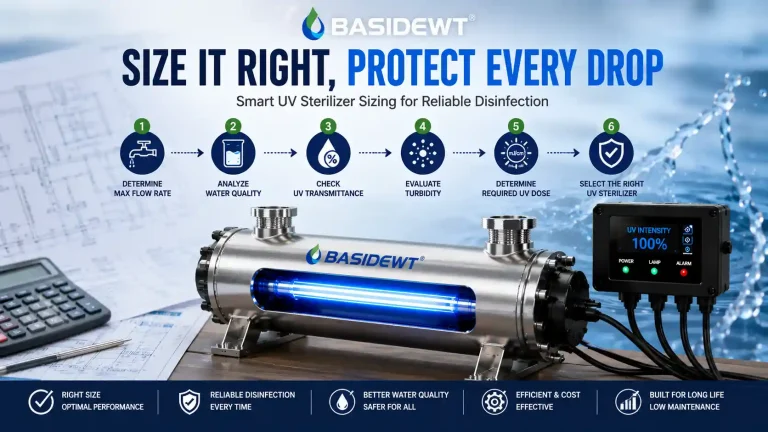
Sizing itself deserves its own careful review rather than a quick estimate. Working through how to size a UV water sterilizer for the specific property, including peak demand, gives a much more reliable result than sizing off average consumption figures alone. For residential drinking water specifically, it’s also worth reviewing how UV sterilization applies to drinking water applications, since drinking water use often has stricter expectations than general household supply.
Conclusion
A whole house UV water sterilizer treats water at the point of entry, so every tap, shower, and appliance in a property draws from a supply that has already passed through UV disinfection. It works by exposing microorganisms to germicidal UV light as water flows through a sealed chamber, and it performs best as part of a properly sequenced treatment train rather than as a standalone fix.
Correct sizing matters. Peak simultaneous demand, not just average consumption, determines whether the system delivers adequate UV dose when it matters most. Water clarity and pretreatment quality matter just as much, since UV cannot compensate for sediment, hardness, or chemical issues further upstream.
For villas, hotels, schools, and small commercial facilities across China dealing with private wells, stored water, or variable source quality, a properly sized whole house UV sterilizer can serve as a practical final disinfection stage. For properties on well-monitored municipal supply with no known contamination history, water testing is the more useful first step before investing in a system.
BasideWT works with residential and commercial customers, OEM buyers, and water treatment companies to match UV sterilizer capacity and configuration to real water conditions and actual system demand. If you’re evaluating a whole house UV water sterilizer for a specific property, sharing your water source details and flow requirements is the most direct way to get a recommendation that fits.
RELATED POSTS
What Size Whole House Water Softener and Filtration System Do I Need for My Home?
Water Filter System: How It Works, Types, Benefits & Buying Guide
UF Membrane Cleaning & Backwashing: Complete Maintenance Guide
How to Size a UV Water Sterilizer for Your Water System
Water Softener System for Well Water: Benefits, Problems & How to Choose the Right One