BasideWT- Whole Home Water Filtration System & Replacement


How Does a Deionized Water System Work? A Complete Step-by-Step Guide
If you have ever asked yourself how does a deionized water system work, you are not alone. Manufacturers, lab managers, and plant engineers ask this question every day, because pure water is not a luxury in many industries. It is a requirement. Tap water and even filtered water still carry dissolved minerals, salts, and charged particles that can damage equipment or contaminate sensitive processes. A deionized water system removes those charged particles, called ions, and leaves behind water that is remarkably pure.
This guide breaks the entire process down into simple, practical steps. You will learn how ion exchange resins work, what happens inside the tanks, and why so many industries in China rely on this technology daily. If you want a broader overview first, our Deionized Water System Buying Guide is a helpful starting point before diving into the technical details below.
What Is the Working Principle of a Deionized Water System?
At its core, a deionized water system removes dissolved ions from water using a chemical process called ion exchange. Water naturally contains positively charged ions, known as cations, and negatively charged ions, called anions. These include calcium, magnesium, sodium, chloride, and sulfate.
A DI system passes water through specially manufactured resin beads. These beads attract and trap unwanted ions while releasing harmless hydrogen and hydroxide ions in their place. Because hydrogen and hydroxide combine to form pure water, the end result contains almost no dissolved solids at all.
This is precisely how a deionized water system works at the molecular level. Unlike simple filtration, which only removes physical particles, deionization targets the invisible charged particles that filters cannot catch. That distinction matters enormously for industries that need ultra-pure water for sensitive equipment, delicate formulations, or precision manufacturing.
Understanding the Ion Exchange Process
The ion exchange process is the engine that drives every DI water system. It relies on two different resin types working together, each one designed to attract a specific kind of ion. Together, they strip water of nearly all its dissolved mineral content.
Before ion exchange even begins, most facilities run their source water through pretreatment steps such as sediment filtration or reverse osmosis. This step reduces the load on the resin beds and extends their working life. You can read more about this in our article on Membrane Technology in Water Treatment, which explains how membrane-based pretreatment supports downstream deionization.
What Are Cation Exchange Resins?
Cation exchange resins carry a negative charge on their surface. As water flows through the resin bed, positively charged ions such as calcium, magnesium, and sodium stick to the resin. In exchange, the resin releases hydrogen ions into the water.
Think of it like a swap meet. The resin holds onto the unwanted metal ions and hands back a harmless hydrogen ion instead. This step alone removes most of the hardness-causing minerals that create scale in boilers and cooling towers.
What Are Anion Exchange Resins?
Anion exchange resins work in the opposite direction. Their surface carries a positive charge, so they attract negatively charged ions like chloride, sulfate, and nitrate. As these ions bind to the resin, hydroxide ions are released back into the water.
Once the hydrogen ions from the cation stage meet the hydroxide ions from the anion stage, they combine instantly to form H2O. Nothing is left behind except clean, deionized water. To understand resin chemistry in more depth, our detailed guide to Ion Exchange Resin covers resin types, capacity, and selection criteria for different applications.
Step-by-Step: How a Deionized Water System Works
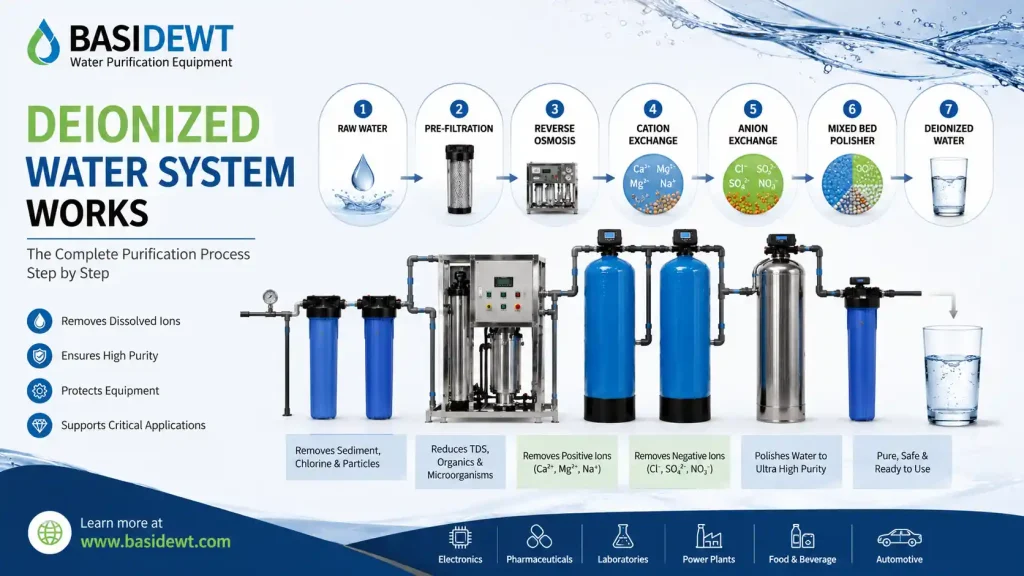
Now that you understand the chemistry, let’s walk through the complete process from start to finish. This is the practical answer to how a DI water system process actually runs on a daily basis inside a facility.
Step 1: Raw water intake. Source water enters the system, whether it comes from a municipal supply, a well, or an internal recycling loop.
Step 2: Pretreatment filtration. Sediment, chlorine, and larger particles are removed first. This protects the resin beds from fouling and premature exhaustion.
Step 3: Reverse osmosis (optional but common). Many industrial setups add an RO stage before deionization. RO removes the bulk of dissolved solids, which means the DI resins only need to polish the water rather than do all the heavy lifting.
Step 4: Cation exchange. Water enters the cation resin tank, where positive ions are swapped for hydrogen ions.
Step 5: Anion exchange. Water then passes through the anion resin tank, where negative ions are swapped for hydroxide ions.
Step 6: Mixing and polishing. In many systems, water flows through a mixed bed polisher containing both resin types blended together. This final pass captures any remaining trace ions.
Step 7: Quality monitoring. Conductivity or resistivity meters continuously check the water. Because pure water conducts almost no electricity, low conductivity readings confirm high purity.
Step 8: Distribution or storage. Finished DI water moves to storage tanks or directly to the point of use, ready for manufacturing, cleaning, or laboratory work.
This sequence explains the deionized water system working principle from beginning to end, and it shows why each stage builds on the one before it.
Main Components Inside a DI Water System
Several components work together to make this process reliable and repeatable. Understanding each part helps operators troubleshoot issues and maintain consistent water quality.
- Pretreatment filters remove sediment, chlorine, and organic matter before water reaches the resin tanks.
- Cation and anion resin vessels house the ion exchange resins that perform the actual deionization.
- Mixed bed vessels combine both resin types for a final purity polish.
- Conductivity meters monitor water purity in real time, alerting operators when resin capacity is running low.
- Regeneration systems restore exhausted resin using acid and caustic solutions, allowing the beads to be reused rather than replaced every cycle.
- Control valves and piping direct water flow between stages automatically.
Facilities that need a compact, ready-to-use solution often choose a pre-engineered Deionized Water Cleaning System rather than assembling individual components. This approach simplifies installation while still delivering consistent, high-purity output.
Mixed Bed vs Separate Bed Deionization
Not every DI system is built the same way, and the layout affects both water quality and operating cost. Two common configurations dominate the industry.
Separate bed systems run cation and anion resins in distinct tanks, one after the other. This design is easier to regenerate, since each resin type can be treated with its specific chemical separately. However, separate beds typically produce water with slightly lower purity compared to mixed beds.
Mixed bed systems blend cation and anion resins together in a single vessel. Because the two resin types interact continuously as water flows through, mixed beds achieve extremely high purity, often used as a final polishing stage. On the other hand, regenerating a mixed bed is more complex, since the resins must be separated before treatment and recombined afterward.
Many industrial setups use both: separate beds to handle the bulk of ion removal, followed by a mixed bed for final polishing. This combination balances cost efficiency with the ultra-high purity that sensitive applications demand.
Choosing between the two configurations usually comes down to purity requirements and budget. A commercial cleaning operation may not need the extremely low conductivity that a semiconductor plant requires, so separate beds alone might be sufficient. Meanwhile, a laboratory preparing reagent-grade water almost always needs the mixed bed stage, since even trace ions can interfere with sensitive test results. Understanding this trade-off early helps buyers avoid overpaying for purity they do not need, or underinvesting in purity their process cannot function without.
Why Industries Need High-Purity DI Water
Once you understand how a deionized water system works, it becomes clear why so many sectors depend on it. Dissolved minerals may seem harmless in drinking water, but they cause real problems in industrial and technical settings.
Electronics manufacturing requires ultra-pure water to rinse semiconductor wafers and circuit boards. Even trace minerals can leave residue that ruins microscopic components.
Pharmaceutical production relies on DI water to prepare formulations, clean equipment, and meet strict regulatory purity standards.
Laboratories use deionized water for reagent preparation, sample dilution, and analytical testing, where any contamination could skew results.
Power generation facilities feed DI water into boilers to prevent scale buildup, which reduces efficiency and can damage turbines over time.
Commercial cleaning operations use DI water because it dries without leaving spots, streaks, or mineral residue on glass and metal surfaces.
Across all of these applications, the goal is the same: eliminate ions that would otherwise interfere with a precise process. Industries that also need particulate removal alongside deionization often pair their setup with broader Industrial Water Filtration Systems to cover every stage of contamination control.
Consider a mid-sized electronics plant as a practical example. Before installing a DI system, the plant may notice frequent spotting on finished circuit boards after rinsing. This spotting usually traces back to mineral deposits left behind by ordinary tap water. Once deionized water replaces standard rinse water, those deposits disappear almost immediately. The same pattern shows up in commercial glass cleaning, vehicle detailing, and precision optics manufacturing, where any leftover residue is visible to the naked eye. In each case, the fix is not a stronger filter. It is the removal of dissolved ions themselves, which only deionization can achieve.
Factors That Affect DI Water Quality
Several variables influence how consistently a DI system produces high-purity water. Recognizing these factors helps operators catch problems before they affect production.
Feed water quality plays a major role. Water with high mineral content exhausts resin faster, which shortens the time between regeneration cycles.
Flow rate matters too. Water moving too quickly through the resin bed may not have enough contact time to exchange all its ions, which lowers output purity.
Resin condition naturally degrades with use. Over time, resin beads lose capacity and require regeneration or eventual replacement.
Temperature can affect resin performance, since extreme temperatures may reduce exchange efficiency or damage the resin structure.
Conductivity and TDS levels are the most direct indicators of water purity. Because pure water resists electrical conductivity, rising conductivity signals that ions are slipping through. Our article on What Does a TDS Meter Measure? explains this relationship in more detail, including how total dissolved solids readings connect to real-world water quality.
According to research published by the Academy of International Program in Shenzhen, ion exchange resin performance depends heavily on flow direction and regeneration technique, since improper handling can noticeably reduce exchange efficiency over repeated cycles.
Regeneration chemistry deserves special attention here. Cation resin is typically regenerated with an acid solution, while anion resin requires a caustic, or base, solution. During regeneration, the captured ions are washed away, and the resin returns to its original hydrogen or hydroxide form. If regeneration is rushed or the wrong chemical concentration is used, the resin will not fully reset. As a result, the next production cycle starts with reduced capacity, and purity drops sooner than expected. This is why experienced operators treat regeneration as a precise procedure rather than a quick rinse.
Tips to Maintain Peak System Performance
A DI water system performs best when it receives regular attention. Small maintenance habits prevent larger, more expensive problems down the line.
Monitor conductivity daily. Consistent tracking helps you catch resin exhaustion early, before water quality drops below acceptable limits.
Test TDS regularly. Routine testing confirms that your system is meeting purity targets. Our guide on How to Check TDS with a TDS Meter walks through the exact steps for accurate readings.
Schedule resin regeneration. Waiting too long between regeneration cycles allows exhausted resin to release previously captured ions back into the water.
Inspect pretreatment filters. Clogged or worn filters place extra strain on resin beds, which shortens their usable life.
Keep detailed maintenance logs. Recording flow rates, conductivity readings, and regeneration dates helps identify patterns and predict when service is needed.
Replace resin when necessary. Even with regular regeneration, resin eventually loses capacity permanently and must be replaced to restore full performance.
Consistent maintenance is often the difference between a system that delivers reliable purity for years and one that requires constant troubleshooting.
Final Thoughts
So, how does a deionized water system work in the end? It comes down to a straightforward but powerful chemical exchange. Cation resins remove positive ions, anion resins remove negative ions, and the two combine to leave nothing behind but pure water.
From pretreatment through final polishing, every stage plays a role in delivering the purity that modern industries depend on. Whether you run a laboratory, a pharmaceutical plant, or an electronics facility, understanding this process helps you choose the right system and maintain it correctly.
If you are still deciding which setup fits your operation, our Deionized Water System Buying Guide and our What Is a Deionized Water System overview both offer practical next steps toward finding a solution that matches your purity requirements.
RELATED POSTS
Types of RO Membranes: Complete Guide to Choosing the Right Type
UF Membrane for Well Water: Selection, Performance & Maintenance
RO Water System Maintenance Guide: Tips to Extend Performance & Lifespan
Reverse Osmosis Ro Water Storage Sank -BasideWT
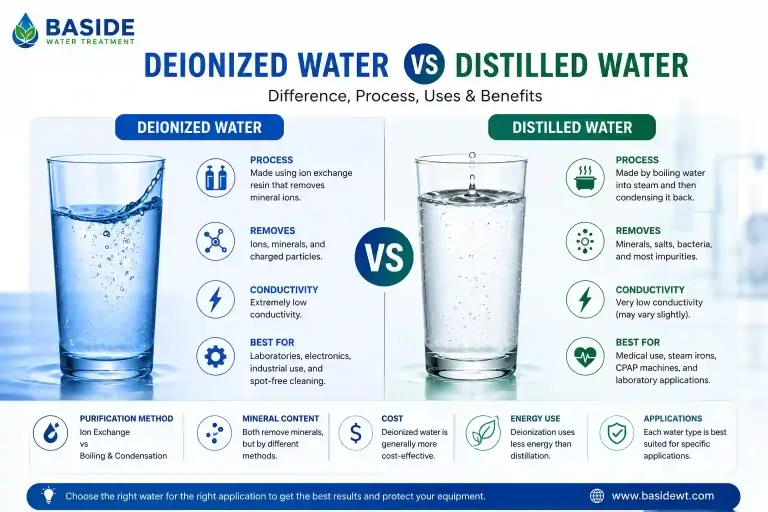
Deionized Water vs Distilled Water: What’s the Real Difference?