BasideWT- Whole Home Water Filtration System & Replacement

Deionized Water vs Reverse Osmosis Water: What’s the Difference?
Water purity is not a single standard. It changes depending on what you make, test, or clean. That is why the question of Deionized Water vs Reverse Osmosis Water comes up so often among industrial buyers, lab managers, and manufacturers across China.
Both methods produce clean water. However, they remove different things, work through different processes, and suit different jobs. Understanding this difference helps you avoid costly mistakes, whether you run a pharmaceutical plant, an electronics assembly line, or a commercial cleaning business.
This article breaks down how each technology works, where each one excels, and why so many facilities end up combining both. If you are still building your foundational knowledge, our Deionized Water System Buying Guide is a good starting point before diving into this comparison.
What Is Reverse Osmosis Water?
Reverse osmosis (RO) water is water that has passed through a semi-permeable membrane under pressure. This membrane blocks dissolved salts, bacteria, and most organic compounds while letting water molecules through.
RO systems typically remove 95% to 99% of total dissolved solids (TDS). The result is water that is far cleaner than tap water, but it is not completely free of ions.
Some people confuse RO water with distilled water because both are considered “purified.” They are not the same thing, though. Our article on Reverse Osmosis Water vs Distilled Water explains the process differences in more detail.
What Is Deionized Water?
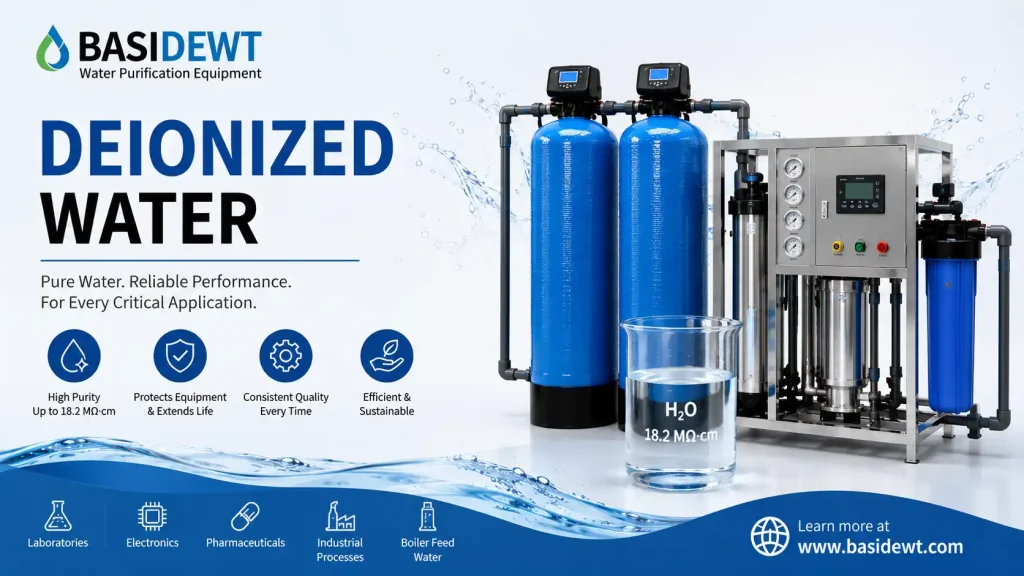
Deionized (DI) water goes a step further. It uses ion-exchange resins to strip out virtually all charged particles, including calcium, magnesium, sodium, chloride, and other mineral ions.
Unlike RO, deionization does not physically filter out bacteria, viruses, or organic molecules that carry no electrical charge. Instead, it targets ions specifically, which is why DI water can reach extremely low conductivity readings.
If you want a full technical breakdown of the equipment involved, see What Is a Deionized Water System for a complete overview.
How Reverse Osmosis Works
Reverse osmosis reverses the natural flow of osmosis. Instead of water moving toward a higher-concentration solution, pressure forces water through a membrane away from dissolved contaminants.
The RO Purification Process
- Pre-filtration removes sediment, chlorine, and larger particles that could damage the membrane.
- Pressurized filtration pushes water through a semi-permeable membrane with pores small enough to block salts and most organics.
- Separation splits the flow into permeate (purified water) and concentrate (rejected water containing removed contaminants).
- Post-treatment, when needed, polishes the water further before use or storage.
Because RO relies on physical filtration, it also removes bacteria, viruses, and larger organic molecules. This makes it effective for a wide range of source waters, including brackish water and seawater in some industrial setups.
How Deionized Water Works
Deionization uses two types of ion-exchange resin: cation resin and anion resin. As water flows through these resin beds, ions swap places with hydrogen and hydroxide ions bound to the resin.
The DI Purification Process
- Cation exchange replaces positively charged ions (like calcium and sodium) with hydrogen ions.
- Anion exchange replaces negatively charged ions (like chloride and sulfate) with hydroxide ions.
- Recombination occurs as hydrogen and hydroxide ions combine to form pure water molecules.
- Mixed-bed polishing, in many systems, blends both resins together for a final purity boost.
This process is extremely effective at lowering conductivity, but it does not remove particles, bacteria, or non-ionic organic compounds. That is why DI systems are usually paired with pre-filtration or RO. For a deeper technical walkthrough, read How Does a Deionized Water System Work.
Deionized Water vs Reverse Osmosis Water: Key Differences
The table below summarizes how RO water and DI water compare across the factors that matter most to industrial buyers.
| Factor | Reverse Osmosis Water | Deionized Water |
|---|---|---|
| Purification method | Physical membrane filtration | Ion-exchange resin |
| TDS removal | 95% to 99% | Up to 99.9%+ |
| Mineral/ion removal | High, but not complete | Near-total |
| Bacteria/virus removal | Yes, through membrane filtration | No, resin does not filter microbes |
| Organic compound removal | Moderate to high | Low for non-ionic organics |
| Operating cost | Moderate; energy for pressure pump | Lower per gallon, but resin needs regeneration |
| Maintenance | Membrane replacement, periodic cleaning | Resin regeneration or replacement |
| Typical resistivity | Up to 1–15 megohm-cm | Up to 18.2 megohm-cm (ultrapure) |
| Waste generation | Produces reject/concentrate water | Minimal waste in closed-loop systems |
As the table shows, DI water vs RO water is not a matter of one being universally “better.” Each addresses a different type of contamination.
Cost Considerations Beyond the Upfront Price
Operating costs deserve extra attention because they shift over time. RO systems consume energy to maintain pressure across the membrane, and membranes eventually foul or degrade, which raises replacement costs.
DI systems avoid the pressure requirement, but resin exhausts faster when source water carries a heavy ion load. Facilities that skip RO pre-treatment often find themselves regenerating resin far more often than expected, which quietly inflates long-term expenses.
Which One Produces Higher Water Purity?
If purity is measured strictly by ion content, deionized water usually wins. DI systems can push resistivity close to the theoretical maximum of 18.2 megohm-cm, which is the benchmark for ultrapure water used in semiconductor fabrication.
Why RO Alone Cannot Match DI Purity
RO membranes still allow a small percentage of dissolved ions through, particularly smaller monovalent ions like sodium and chloride. Over time, membrane fouling can also reduce rejection rates.
DI resin, on the other hand, can theoretically capture nearly every ion in the water, as long as the resin has not reached exhaustion. This is why laboratories and electronics manufacturers requiring high purity often rely on ion-exchange technology as a final polishing step, not RO alone.
That said, purity is not the only consideration. RO systems handle a broader range of contaminants, including microorganisms that DI resin cannot touch.
Applications of RO Water
Reverse osmosis water suits situations where broad-spectrum contaminant removal matters more than achieving near-zero conductivity.
Common RO Applications
- Drinking water production for bottling plants and commercial facilities, since RO removes bacteria along with dissolved salts.
- Boiler feed water in industrial plants, where scale-forming minerals must be reduced before heating.
- Food and beverage processing, where consistent water quality affects product taste and shelf life.
- Pre-treatment for DI systems, reducing the ion load before water reaches resin beds.
- Car washing and window cleaning, where spot-free rinsing depends on low mineral content rather than ultrapure water.
Many people also wonder about the health implications of RO water for daily consumption. That topic is covered separately in Is Reverse Osmosis Water Good for You?
Applications of DI Water
Deionized water is the standard choice wherever even trace minerals could interfere with a process or a result.
Common DI Applications
- Laboratory use, including reagent preparation, glassware rinsing, and analytical testing, where mineral residue could skew results.
- Electronics manufacturing, where DI water rinses circuit boards and semiconductor wafers without leaving conductive mineral deposits.
- Pharmaceutical production, where water purity directly affects product safety and regulatory compliance.
- Battery manufacturing, where ion contamination can shorten battery life or cause performance issues.
- Spot-free rinsing for high-end vehicles and glass surfaces, where DI water leaves no mineral streaks after air-drying.
Facilities that need consistent, high-volume DI output often invest in a dedicated setup like our Deionized Water Cleaning System, which is built for demanding commercial and industrial use.
When Should You Use an RO + DI Water System?
In practice, many industries do not choose between RO and DI. They use both, in sequence, because each technology compensates for the other’s weaknesses.
Why Combine RO and DI
RO removes the bulk of dissolved solids, bacteria, and organic material first. This protects the DI resin from being overwhelmed, since resin capacity is limited and expensive to regenerate.
DI then polishes the RO output, stripping out the remaining trace ions that RO could not catch. The result is water that meets both microbiological and ionic purity standards.
Real-World Industrial Examples
A semiconductor plant, for instance, typically runs source water through multi-stage RO before sending it to mixed-bed DI polishers, achieving the ultrapure water needed for wafer rinsing. Similarly, pharmaceutical manufacturers often combine RO with DI or electrodeionization to meet purified water standards set by industry guidelines.
According to a widely referenced industry explainer on water treatment fundamentals, combining reverse osmosis with ion-exchange methods is generally more cost-effective and technically sound than relying on ion exchange alone for higher-salinity source water. This aligns with what most process engineers observe in practice: RO handles the heavy lifting, and DI delivers the final polish.
For businesses exploring broader filtration options beyond DI alone, our Industrial Water Filtration Systems category page covers additional configurations worth considering.
How to Choose the Right System for Your Business
Choosing between RO, DI, or a combined system depends on a few practical questions.
Questions to Ask Before Deciding
- What purity level does your process actually require? Drinking water and car washing need less stringent purity than semiconductor rinsing.
- What is in your source water? High bacterial content favors RO; high mineral content favors DI polishing.
- What is your production volume? Higher volumes may justify a combined system to reduce resin regeneration frequency.
- What are your long-term operating costs? RO membranes and DI resin both wear out, but at different rates depending on water quality and usage.
- Are there regulatory requirements? Pharmaceutical and electronics manufacturing often have documented purity standards that dictate the treatment train.
Reviewing these factors against your specific application makes the decision far clearer. For a more detailed walkthrough of system components and sizing, the Deionized Water System Buying Guide offers additional guidance.
A Simple Way to Frame the Decision
Think of RO as the workhorse and DI as the finishing touch. If your process can tolerate trace minerals but cannot tolerate bacteria or heavy sediment, RO alone may be sufficient.
If your process demands near-zero conductivity, such as rinsing microchips or preparing lab reagents, DI becomes essential, usually working alongside RO rather than replacing it. Skipping this pairing tends to shorten equipment life and raise long-term costs, since unfiltered contaminants place extra strain on downstream components.
Distributors and importers evaluating equipment for Chinese manufacturing clients should also factor in local water quality. Source water across different regions varies widely in hardness and TDS, which directly affects how quickly resin or membranes need servicing.
Final Thoughts
The debate over Deionized Water vs Reverse Osmosis Water does not have a single winner. RO excels at removing bacteria, sediment, and the bulk of dissolved solids. DI excels at achieving near-total ion removal for applications where trace minerals cannot be tolerated.
For many manufacturers, laboratories, and commercial operators, the smartest approach is not choosing one over the other. It is combining RO and DI into a single treatment train that delivers both broad contaminant removal and ultrapure output.
Understanding this distinction helps you specify the right equipment, avoid unnecessary costs, and meet the purity standards your industry demands.
RELATED POSTS
RO Membrane: Types, Sizes, GPD, Working, Replacement & Buying Guide
UF Membrane for RO Pretreatment: Why and When Is It Used?
PVDF vs PES UF Membrane: Which Is Better?
Industrial Water Filter Housing Applications: Industries, Benefits & Selection Guide
why is my water filter leaking?