BasideWT- Whole Home Water Filtration System & Replacement


Water Softener System Cost Guide: Prices, Installation & Long-Term Value
This Water Softener System Cost Guide exists because most buyers ask the wrong question first. They ask, “What is the cheapest option?” instead of asking, “What will this system actually cost me over ten years?” That single shift in thinking separates buyers who feel satisfied with their purchase from buyers who regret it within twelve months.
A low sticker price often hides higher salt use, frequent repairs, or premature valve failure. A slightly higher upfront cost can deliver lower running expenses and a longer service life. So before comparing brands or models, it helps to understand every cost layer involved: purchase price, installation, and ongoing operation. Once you see the full picture, you can judge value instead of just price.
This guide breaks down each cost component in plain terms. It also shows how commercial buyers, distributors, and homeowners can budget realistically for a water softener system that fits their water hardness, household size, or facility demand.
What Does a Water Softener System Cost?
Water softener cost varies widely because no two households or facilities share identical needs. Instead of quoting fixed prices that change by region and supplier, it helps to understand the categories that shape the final number.
Residential systems typically fall into three tiers: entry-level, mid-range, and premium. Entry-level units use basic timer-based valves and standard resin. They cost less initially, but they regenerate on a fixed schedule regardless of actual water use, which wastes salt and water. Mid-range systems add demand-initiated regeneration, which only triggers when the resin bed actually needs recharging. Premium systems include smart metering, higher-grade resin, and longer warranties.
Commercial water softener systems scale differently. Facilities such as hotels, restaurants, laundromats, and manufacturing plants need higher flow rates and larger resin tanks. Consequently, commercial units cost significantly more than residential models, though the price reflects durability and continuous-duty performance rather than luxury features.
For buyers weighing salt-based against salt-free options, cost differences extend beyond the unit itself. If you’re still deciding between technologies, our comparison of salt-based and salt-free systems explains how each approach affects long-term spending.
Ultimately, entry-level models suit light residential use, while premium and commercial-grade systems serve households or businesses with heavy demand, high hardness levels, or strict water quality requirements.
OEM buyers, importers, and distributors face a slightly different calculation. Bulk purchasing often lowers the per-unit water softener price, yet quality still matters more than volume discounts. A batch of poorly built units can generate warranty claims and reputation damage that outweigh any upfront savings. Consequently, sourcing partners who prioritize consistent manufacturing standards tends to protect margins better than chasing the lowest possible price per unit.
Water treatment companies and installers also weigh cost differently than individual homeowners. They typically stock a range of tiers so they can match each client’s budget and water quality needs. Because these professionals see long-term performance data across many installations, their pricing guidance often reflects real-world durability rather than marketing claims alone.
Factors That Affect Water Softener System Cost
Several variables push the price up or down. Understanding them helps you avoid overpaying for features you don’t need, or underpaying for capacity you do need.
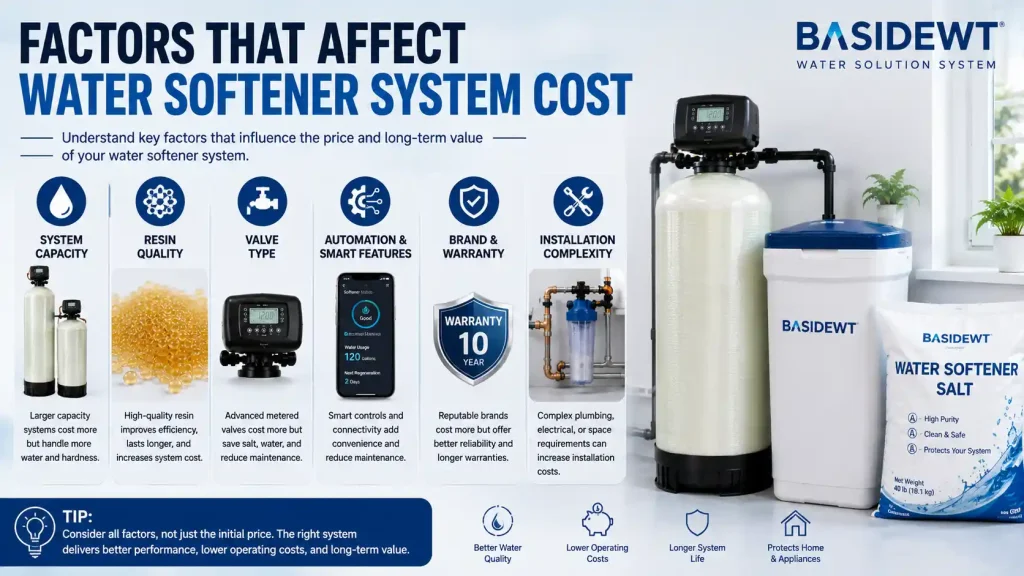
Capacity is the biggest driver. Larger resin tanks and higher grain capacity cost more because they handle more water between regeneration cycles. A system sized for a family of two costs less than one built for a family of six or a small hotel.
Resin quality matters just as much as tank size. High-quality resin lasts longer, removes hardness minerals more efficiently, and resists fouling from iron or sediment. Cheaper resin degrades faster and requires earlier replacement, which raises long-term cost even if the initial price looks attractive.
Valve type influences both price and performance. Basic timer valves cost less, but they regenerate on a schedule rather than actual usage. Metered valves cost more upfront, yet they reduce salt and water waste by regenerating only when necessary.
Automation and smart features add convenience. Bluetooth connectivity, app-based monitoring, and automatic diagnostics increase the purchase price, but they also help you catch problems early, which can prevent costly downtime.
Brand reputation affects cost too. Established manufacturers often charge a premium for proven reliability and stronger warranty support. That said, lesser-known brands can still offer excellent value if they use quality components.
Installation complexity and water hardness levels in your area also shape the final investment. Harder water demands more frequent regeneration, larger resin volume, or additional pre-treatment, all of which raise both purchase and operating costs.
Installation Costs Explained
Installation cost depends on more than labor rates. It hinges on how your existing plumbing, electrical access, and drainage setup align with the new system’s requirements.
Homes with easily accessible main water lines and nearby drains generally see lower installation costs. Homes that require rerouting pipes, adding a dedicated electrical outlet, or extending drain lines will naturally cost more, because these tasks require additional materials and labor hours.
Commercial installations add another layer of complexity. Facility managers often need to coordinate with plumbers, electricians, and sometimes structural engineers, especially when installing large-capacity commercial water softener units. Permits, code compliance, and system bypass valves for uninterrupted operation can also affect the final bill.
Professional installation, rather than a do-it-yourself approach, typically costs more initially. However, professional setup reduces the risk of leaks, incorrect bypass configuration, or improper drainage, all of which can lead to expensive repairs later. If you want a full breakdown of the installation process itself, our step-by-step installation guide walks through what to expect before hiring a professional.
Operating Costs Over Time
Purchase price only tells part of the story. Operating costs accumulate month after month, and they often determine whether a system delivers real value.
Salt consumption represents the most consistent ongoing expense for salt-based systems. Usage depends on water hardness, household size, and how efficiently the valve regenerates. Systems with demand-initiated regeneration use noticeably less salt than timer-based models, because they avoid unnecessary cycles. For guidance on choosing the right product, our water softener salt guide explains how salt type influences both performance and cost.
Electricity usage stays relatively low for most residential units, since the control valve only draws power during regeneration. Commercial systems with continuous monitoring or larger pumps consume more, though the difference rarely dominates a facility’s overall energy bill.
Water used during regeneration adds a smaller but measurable cost. Older or poorly maintained systems waste more water than necessary, while modern metered valves minimize this by regenerating only when the resin bed actually needs it.
Routine servicing and replacement parts, such as resin beds, O-rings, and injectors, also factor into total operating cost. Systems built with durable components need fewer replacements, which reduces long-term spending even if they cost more initially.
It also helps to think about operating costs seasonally rather than as a flat monthly figure. Households often use more water during summer months, which naturally increases salt and water consumption during regeneration. Facility managers running commercial water softener systems should budget for these seasonal swings instead of assuming a fixed cost year-round.
Another overlooked expense involves brine tank cleaning and occasional resin bed rinsing, which prevent salt bridging and mushing. While these tasks don’t require professional service in most cases, skipping them can force earlier resin replacement, which raises long-term cost unnecessarily.
The table below summarizes typical cost behavior across system tiers, without relying on fixed regional pricing.
| Cost Category | Entry-Level System | Mid-Range System | Premium/Commercial System |
|---|---|---|---|
| Salt Usage | Higher (timer-based) | Moderate (metered) | Lower (smart metered) |
| Water Waste | Higher | Moderate | Lowest |
| Electricity Use | Minimal | Minimal to moderate | Moderate |
| Maintenance Frequency | Frequent | Occasional | Rare |
| Component Lifespan | Shorter | Moderate | Longest |
Is a Water Softener Worth the Investment?
For most households and businesses dealing with hard water, the answer is yes. However, the value depends on how you measure return on investment.
Appliance protection is one of the clearest benefits. Hard water leaves mineral scale inside water heaters, dishwashers, and washing machines. Over time, this scale reduces efficiency and shortens appliance lifespan. A whole house water softener prevents this buildup, which extends the life of expensive equipment.
Reduced maintenance follows naturally. Softened water keeps pipes, faucets, and fixtures free from scale, which means fewer clogs and less frequent plumbing repairs.
Energy savings occur because scale-free water heaters and boilers operate more efficiently. Even a thin layer of scale forces heating elements to work harder, which raises utility bills gradually over time.
Plumbing lifespan improves as well. Hard water accelerates corrosion and mineral buildup inside pipes, particularly in older homes. Softened water slows this process considerably.
Long-term savings add up when you combine these factors. The table below compares typical outcomes between hard water and softened water over a multi-year period.
| Impact Area | Hard Water Household | Softened Water Household |
|---|---|---|
| Appliance Lifespan | Shortened by scale buildup | Extended significantly |
| Water Heater Efficiency | Declines over time | Remains stable |
| Plumbing Repairs | More frequent | Less frequent |
| Soap and Detergent Use | Higher due to poor lathering | Lower, more efficient use |
| Overall Long-Term Cost | Higher | Lower |
Consequently, while the upfront investment feels significant, the cumulative savings on appliances, energy, and plumbing repairs usually justify the cost within a few years.
How to Reduce the Total Cost of Ownership
Smart buyers can lower long-term spending without sacrificing performance. A few practical strategies make a real difference.
First, choose a system sized correctly for your water usage and hardness level. Oversized systems waste salt and water, while undersized systems regenerate too often, which shortens component lifespan. Our complete buying guide offers a structured approach for matching capacity to actual need.
Second, prioritize demand-initiated regeneration over timer-based valves. The higher upfront cost typically pays for itself through reduced salt and water consumption within one to two years.
Third, invest in quality resin and components even if the initial price feels higher. Durable parts reduce replacement frequency, which lowers total spending over the system’s lifespan.
Fourth, schedule routine maintenance rather than waiting for problems to appear. Preventive care costs far less than emergency repairs, and it keeps the system running at peak efficiency.
Finally, test your water hardness periodically. Conditions change, especially in areas with seasonal fluctuations or shared municipal supplies, so periodic testing ensures your system continues operating at the correct settings.
Common Cost Mistakes Buyers Make
Even experienced buyers fall into predictable traps when budgeting for a water treatment system. Recognizing these mistakes early can save significant money.
Buying the cheapest system available often backfires. Low-cost units frequently use inferior resin and basic valves, which leads to higher salt use, more frequent regeneration, and shorter equipment life.
Ignoring operating costs creates a false sense of savings. A buyer who focuses only on purchase price may overlook years of elevated salt, water, and maintenance expenses that eventually exceed what a better system would have cost.
Oversizing the system wastes money upfront and increases ongoing salt and water use unnecessarily. Bigger is not always better, especially for smaller households.
Undersizing, on the other hand, forces the system to regenerate too frequently, which accelerates wear on valves and resin. Our sizing guide explains how to calculate the right capacity based on household size and water hardness.
Ignoring water quality testing before purchase leads to mismatched systems. Without knowing your actual hardness level and mineral content, you risk buying a unit that either underperforms or costs more than necessary.
A related mistake involves skipping professional consultation entirely. Buyers who choose a system based on online reviews alone, without factoring in their specific water hardness or usage patterns, often end up with equipment that underdelivers. Engineers and installers can assess local water conditions and recommend a system that matches actual demand, which prevents costly guesswork.
According to the Lenntech Knowledge Center, understanding total lifecycle cost, rather than focusing solely on equipment price, remains one of the most reliable ways to evaluate water treatment investments across residential and industrial applications alike.
Conclusion
This Water Softener System Cost Guide shows why total cost of ownership matters more than the number on a price tag. Purchase price, installation, and operating expenses all combine to determine whether a system delivers genuine value over time.
Buyers who consider salt consumption, electricity use, maintenance frequency, and component durability make smarter decisions than those who compare upfront prices alone. Whether you’re outfitting a single household or specifying equipment for a commercial facility, understanding these cost layers helps you invest with confidence.
For a broader look at how water softener systems work, their benefits, and how to select the right option for your needs, explore our complete Water Softener System buying guide. It ties together everything covered in this cost breakdown and the rest of our supporting resources.
RELATED POSTS
Which Water Filter System Is Best for Your Home?
How Much Does a UV Water Treatment System Cost?
Water Filter Housing for RO Systems: Types, Applications & Selection Guide
What Is a Whole Home Water Filtration System?
Water Filter Housing Maintenance: Cleaning, Inspection & Care Guide