BasideWT- Whole Home Water Filtration System & Replacement


How to Choose the Right Water Softener System: A Complete Buying Guide
Choosing the right water softener system is one of the most important decisions you’ll make for your home or business water supply. Learning how to choose the right water softener system helps you avoid wasted money, poor water quality, and unnecessary maintenance. This complete buying guide explains how to choose the right water softener system by comparing system types, sizing, flow rate, grain capacity, and installation requirements. Whether you’re buying for a home or a commercial facility, you’ll be able to make a confident decision. If you’re new to water softeners, our complete guide to Water Softener System Types, Benefits, and Installation is a great place to start.
Why Choosing the Right Water Softener System Matters Before You Buy
A water softener system does more than remove hardness minerals. It protects your pipes, appliances, and water heater from scale buildup. However, an undersized or mismatched unit won’t deliver those benefits consistently.
For instance, a system with too little grain capacity will regenerate constantly, wasting salt and water. Meanwhile, an oversized system for a small household sits idle most of the time, which shortens resin life. Because of this, matching the system to your actual needs is essential.
Additionally, the right water softening system reduces long-term operating costs. Homeowners who choose correctly typically see lower energy bills, since scale-free appliances run more efficiently. Therefore, the upfront research pays off for years afterward.
If you’d like a broader overview before diving into specifics, our complete guide to water softener types, benefits, and installation covers the fundamentals in depth.
How to Choose the Right Water Softener System by Testing Your Water
Before comparing products, you need to understand what’s actually in your water. Skipping this step is one of the most common buying mistakes.
Water Hardness
Water hardness is measured in grains per gallon (GPG) or parts per million (PPM). Generally, anything above 7 GPG is considered hard water. Consequently, this number determines the grain capacity you’ll need from your chosen system.
Total Dissolved Solids (TDS)
TDS reflects the overall mineral content in your water, including calcium, magnesium, and other dissolved substances. High TDS levels can affect taste and may indicate the need for additional filtration alongside softening.
Iron Content
Iron is a common issue in well water. Even small amounts can stain fixtures and clog resin beads over time. As a result, if your test shows notable iron levels, you’ll want a system specifically rated to handle it.
Water Analysis
A professional water analysis or a reliable at-home test kit gives you accurate numbers to work with. For a deeper technical breakdown of hardness testing methods, the Pentair Learning Center offers helpful educational resources on water quality fundamentals.
Once you know your water’s exact composition, choosing between softener types becomes far easier.
Different Water Softener Systems to Help You Choose the Right Water Softener System
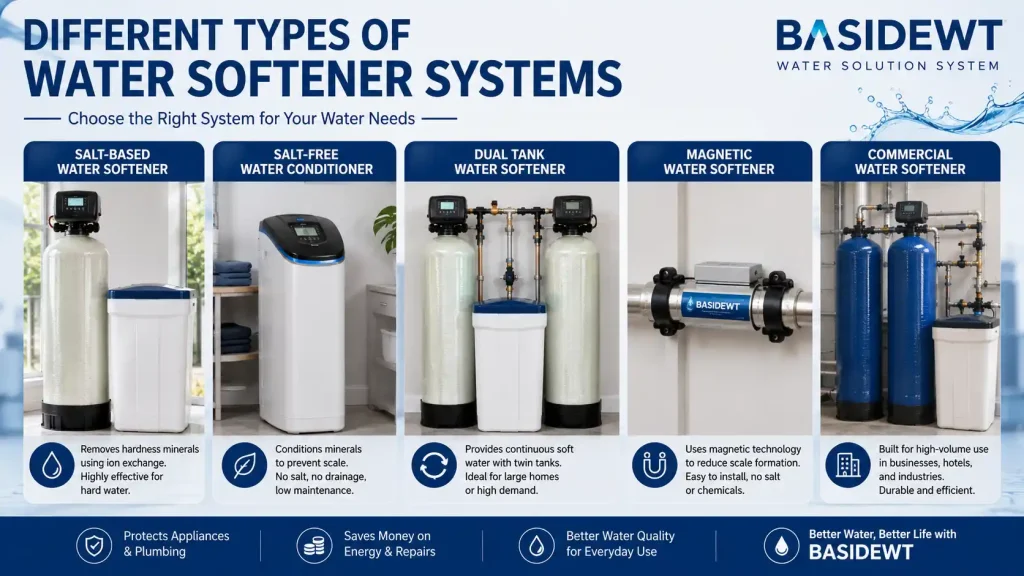
Not every water softener system works the same way. Understanding the differences helps you avoid buying something that doesn’t fit your situation. To see how the softening process actually works once installed, check out our guide on how a water softener system works step by step.
Salt-Based Systems
These use ion exchange resin to remove calcium and magnesium, replacing them with sodium ions. They’re highly effective for genuinely hard water and remain the industry standard.
Salt-Free Systems
Rather than removing minerals, salt-free systems condition them so they can’t form scale. They require no salt or drainage, though they don’t technically “soften” water in the traditional sense.
Dual Tank Systems
Dual tank units provide continuous soft water because one tank regenerates while the other stays in service. This makes them ideal for larger households or businesses with constant demand.
Magnetic Systems
Magnetic or electronic descalers use magnetic fields to alter mineral behavior. They’re low-cost and easy to install, but results vary depending on water conditions.
Commercial Systems
Commercial water softener units are built for high-volume use, often in restaurants, hotels, or manufacturing facilities. They typically feature larger tanks and higher flow rates.
| System Type | Best For | Salt Required | Maintenance Level |
|---|---|---|---|
| Salt-Based | Whole house, hard water | Yes | Moderate |
| Salt-Free | Scale prevention, low maintenance | No | Low |
| Dual Tank | Large households, businesses | Yes | Moderate |
| Magnetic | Budget-friendly, mild hardness | No | Low |
| Commercial | High-volume facilities | Usually | High |
For a closer comparison of the two most popular options, our article on salt-based vs salt-free water softeners breaks down the pros and cons in detail.
Factors to Consider Before Buying
Beyond system type, several practical factors determine which unit will actually perform well in your home or facility.
Household Size
More people generally means more water usage. Consequently, a family of five needs a higher-capacity system than a single-person household.
Daily Water Usage
Multiply your household size by average daily water consumption per person, roughly 75 gallons, to estimate your total need. This number directly influences the grain capacity you should look for.
Flow Rate
Flow rate, measured in gallons per minute, determines whether your system can keep up during peak usage. If your flow rate is too low, you’ll notice reduced water pressure when multiple fixtures run at once.
Grain Capacity
Grain capacity indicates how many hardness grains the resin tank can remove before it needs regeneration. Choosing correctly here prevents both premature regeneration and unnecessary oversizing.
Regeneration Type
Softeners regenerate on a timer, based on water meter usage, or manually. Meter-based regeneration is generally more efficient because it only regenerates when necessary.
Installation Space
Some systems require separate brine tanks, while others are compact all-in-one units. Consequently, measuring your available space beforehand avoids costly surprises later.
Water Pressure
Finally, confirm that your home’s water pressure falls within the manufacturer’s recommended range. Otherwise, performance may suffer regardless of how well-suited the system seems on paper.
If you’re weighing a softener against a standard filtration unit, our comparison of water softeners versus water filters clarifies which solution addresses your specific water concerns.
Choosing a Water Softener for Homes vs Businesses
Residential and commercial buyers have different priorities, even though both need reliable soft water.
For homes, the focus is usually on balancing capacity with cost and footprint. A typical family home does well with a single-tank salt-based system sized to daily usage and peak flow rate. Compact designs also matter, since most homeowners have limited utility space.
Businesses, on the other hand, need systems that handle continuous, high-volume demand without interruption. A restaurant running dishwashers all day, for example, can’t afford downtime during regeneration. Therefore, commercial buyers often choose dual tank or twin-alternating systems that guarantee soft water around the clock.
Facility managers should also account for water quality consistency across multiple points of use. Because commercial operations often involve stricter regulatory or equipment warranty requirements, oversizing slightly for future growth is a common and sensible strategy.
Regardless of setting, proper installation affects long-term performance significantly. Our step-by-step installation guide walks through the process once you’ve selected your system.
Common Buying Mistakes to Avoid
Even well-informed buyers make avoidable errors during the purchase process.
Buying based on price alone. A cheaper unit often means smaller grain capacity or lower-quality resin, which leads to more frequent replacement.
Skipping the water test. Without knowing your actual hardness and mineral levels, you’re essentially guessing at the right specifications.
Ignoring flow rate. Homeowners frequently focus only on grain capacity while overlooking flow rate, resulting in weak water pressure during high-demand periods.
Overlooking installation space. Some buyers purchase a unit that simply doesn’t fit their utility area, forcing costly modifications.
Choosing the wrong regeneration type. Timer-based regeneration wastes salt and water if it doesn’t match your actual usage pattern.
Avoiding these mistakes upfront saves both money and frustration down the line. If you’d like to browse verified, application-specific options, our soft water system product range includes systems designed for different household and commercial needs.
Questions You Should Ask Before Purchasing
Before finalizing your decision, run through this checklist:
- What is my water’s exact hardness level, measured in GPG?
- How many people or how much daily volume will the system serve?
- What flow rate do I need during peak usage times?
- Does the system’s grain capacity match my household or facility size?
- Which regeneration type suits my usage pattern best?
- Do I have adequate space and drainage access for installation?
- What warranty and resin lifespan does the manufacturer offer?
- Is the system certified for the contaminants present in my water?
Working through these questions with a supplier ensures you get accurate, tailored recommendations rather than a generic sales pitch.
Expert Tips for Choosing the Best Water Softener
Start by prioritizing accurate water testing over brand reputation. A well-matched mid-range system will consistently outperform a premium unit that’s poorly sized for your needs.
Next, consider future changes. If you’re planning renovations, a growing family, or business expansion, choose a system with some capacity buffer built in. This prevents the need for an early upgrade.
Also, pay attention to certifications such as NSF/ANSI standards, which confirm the system meets recognized performance and safety benchmarks. These certifications offer independent verification beyond manufacturer claims.
Finally, think about total cost of ownership rather than just the purchase price. Factor in salt or filter replacement, water usage during regeneration, and expected resin lifespan. For buyers exploring a broader range of filtration and softening equipment together, the water filtration system collection provides options that pair well with softening systems for comprehensive water treatment.
Conclusion
Learning how to choose the right water softener system comes down to understanding your water, your usage patterns, and your available space. Start with a water test, compare system types honestly, and match grain capacity and flow rate to your real-world needs rather than assumptions.
Whether you’re outfitting a single-family home or a commercial facility, taking a methodical approach prevents costly mistakes and ensures reliable soft water for years to come. For further reading, explore our complete water softener system pillar guide, where you’ll find links to every topic covered in this series, from installation to long-term maintenance.
RELATED POSTS
UV Water Sterilizer for Drinking Water: Benefits, Limits and Applications
UF Membrane vs UV vs RO: Which Water Treatment Method Is Better?
Water Fed Pole System Setup: A Complete Equipment and Connection Guide

Where Can I Buy Fast Water Filter Cartridge? Your Quick Guide to BasideWT

Self Car Wash Near Me: Everything You Need to Know to Get a Perfect Clean Every Time