BasideWT- Whole Home Water Filtration System & Replacement


Best Water Softener System: Complete Buyer’s Guide Before You Purchase
Choosing the best water softener system is not just about price or brand recognition. Your water hardness, household size, installation environment, and long-term operating cost all shape what “best” actually means for your situation. A system that works perfectly for one household may perform poorly in another.
This guide walks through every major factor that influences your decision. By the end, you will know exactly what to compare and how to avoid the mistakes that lead to buyer’s remorse.
Whether you are furnishing a single-family home, managing a rental property, or sourcing equipment for a commercial facility, the underlying evaluation process stays the same. Only the scale and specific priorities change.
Before diving into specifics, it helps to understand the broader landscape of options available. Our water softener buying guide covers the fundamentals if you need a refresher before moving forward.
What Makes the Best Water Softener System?
There is no single “best” model that fits every home or business. Instead, the right choice depends on several measurable factors specific to your property.
Understanding these factors first prevents you from overspending on unnecessary features or underbuying a unit that cannot keep up with demand.
Treat this section as your foundation. Every feature and comparison discussed later in this guide builds directly on these four core considerations.
Water Hardness Level
Your local water hardness, measured in grains per gallon, determines how much softening capacity you actually need. Higher hardness levels require larger resin beds and more frequent regeneration cycles.
A simple test kit or a call to your water utility usually provides this number. Skipping this step is one of the most common reasons buyers end up with an undersized system.
Hardness levels vary considerably even within the same city, so relying on general assumptions rarely works well. A direct test remains the most reliable starting point.
Daily Water Consumption
Your household’s daily water usage directly affects how often the unit needs to regenerate. Larger families naturally consume more water, which increases the demand placed on the resin bed.
Consider peak usage days as well, not just average consumption. Weekends, guests, or seasonal changes can temporarily raise your household’s water needs.
Commercial properties should track usage across their busiest operating hours rather than relying on daily averages alone. This approach gives a more accurate picture of true peak demand.
Family or Business Size
A whole house water softener for a family of four requires different capacity than one for a small apartment or a large commercial facility. Sizing incorrectly leads to either wasted capacity or constant regeneration cycles that shorten resin life.
Commercial buyers should also account for future growth. Choosing a system with slightly more capacity than current needs often proves more economical than upgrading later.
Renovations, additions, or new appliances can all shift household demand over time. Building in a small margin of extra capacity protects against these changes.
Water Source (Municipal vs Well Water)
Municipal water and well water present different challenges. Well water often contains iron, sediment, or manganese that require additional pretreatment before softening.
If you rely on well water, capacity calculations and resin selection differ significantly from municipal supply. Our well water buying guide explains these differences in more detail.
Municipal water users generally face more predictable hardness levels, though seasonal treatment changes can still cause minor fluctuations worth monitoring.
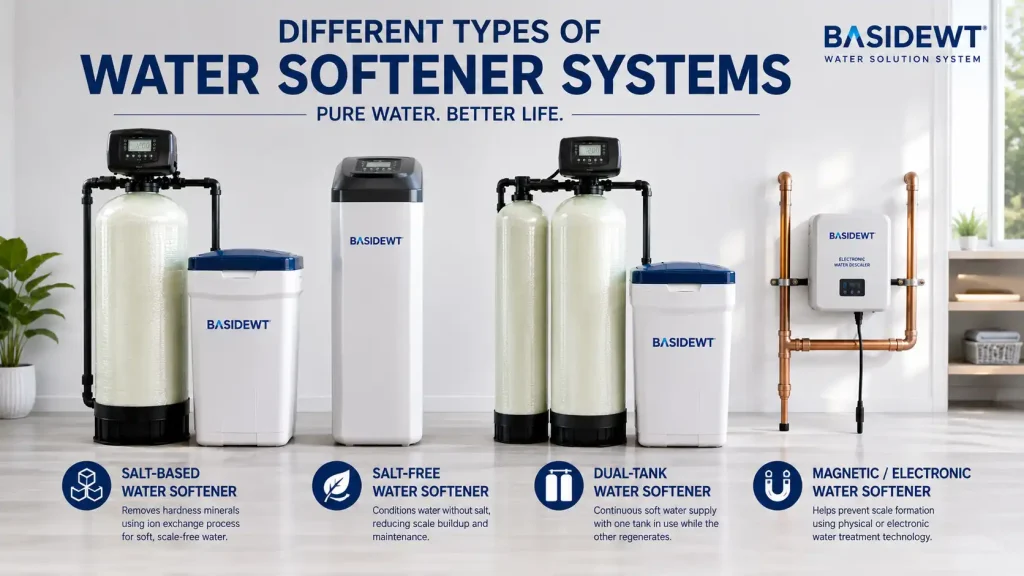
Different Types of Water Softener Systems
Not every softener uses the same technology. Understanding the differences helps you match the right system type to your specific water conditions and goals.
Each technology carries distinct tradeoffs in cost, maintenance, and performance. Reviewing these options carefully now prevents disappointment after installation.
Salt-Based Systems
Salt-based softeners remain the most reliable option for treating genuinely hard water. They use ion exchange to remove calcium and magnesium effectively, which makes them the standard choice for most households.
The main drawback is ongoing salt consumption and the need for periodic maintenance. However, their consistent performance makes them the preferred option when hardness levels are high.
Most water treatment professionals recommend salt-based systems as the default choice unless a specific reason points toward an alternative. Their track record spans decades of reliable residential and commercial use.
Salt-Free Systems
Salt-free systems condition water rather than removing hardness minerals entirely. They work well for households seeking to reduce scale buildup without adding sodium to their water supply.
These systems suit moderate hardness levels better than severe cases. Buyers with very hard water often find salt-free systems insufficient on their own.
Salt-free options also appeal to buyers with dietary sodium concerns or local regulations limiting softener discharge. These factors sometimes outweigh raw softening performance in the final decision.
Dual-Tank Systems
Dual-tank softeners provide continuous soft water because one tank regenerates while the other remains in use. This makes them ideal for large families or commercial applications where water flow cannot be interrupted.
The tradeoff is a larger footprint and higher upfront cost. Even so, many buyers find the added reliability worthwhile for high-demand environments.
Hotels, restaurants, and manufacturing facilities frequently choose dual-tank systems specifically because water flow interruptions directly affect operations and revenue.
Magnetic and Electronic Systems
Magnetic and electronic descalers claim to alter mineral behavior without traditional ion exchange. Results vary significantly depending on water conditions, and many water treatment professionals view these systems as less proven than salt-based alternatives.
These systems may suit buyers looking for a low-maintenance, chemical-free option. However, they generally are not recommended for severely hard water applications.
If you are considering this option, request performance data specific to your hardness level before committing. Manufacturer claims vary widely, and independent verification helps set realistic expectations.
Features to Look for Before Buying
Beyond the basic system type, several technical features separate a reliable water treatment system from a disappointing one.
Buyers who focus only on price often overlook these details, which are usually the true drivers of long-term satisfaction and performance.
Resin quality directly affects softening capacity and lifespan. Higher-grade resin lasts longer and handles higher hardness levels more efficiently. Our resin guide breaks down the differences between common resin types.
Control valve technology determines how accurately the system regenerates. Metered valves, which regenerate based on actual water usage, are generally more efficient than timer-based valves.
Timer-based valves regenerate on a fixed schedule regardless of actual demand, which often wastes salt and water. Metered valves adjust automatically, making them the preferred choice for most modern installations.
Regeneration type affects both water and salt efficiency. Demand-initiated regeneration wastes less than fixed-schedule systems, since it only regenerates when necessary.
Grain capacity should match your household’s hardness level and daily usage. Our sizing guide walks through the calculation in detail.
Salt efficiency and water efficiency ratings indicate how much salt and water the unit uses per regeneration cycle. More efficient systems reduce long-term operating costs significantly.
Warranty coverage reflects manufacturer confidence in the product. Look for at least a five-year warranty on the control valve and a longer warranty on the resin tank.
Certifications, build quality, and maintenance requirements round out the evaluation. A certified system backed by quality components typically costs more upfront but saves money over its lifespan.
Look specifically for independent testing certifications rather than relying solely on manufacturer marketing claims. Third-party verification provides a more reliable measure of actual performance.
Build quality also matters beyond the visible components. Tank material, fitting durability, and corrosion resistance all influence how well a system holds up over years of continuous use.
How to Compare Different Water Softener Systems
Side-by-side comparison makes the decision-making process much clearer. Use the table below as a starting framework when evaluating specific models.
Keep in mind that individual products within each category still vary. Use this table to narrow your category first, then compare specific models using manufacturer specification sheets.
| Factor | Salt-Based | Salt-Free | Dual-Tank |
|---|---|---|---|
| Capacity | High | Moderate | Very High |
| Resin | Ion exchange resin | Template-assisted media | Ion exchange resin |
| Regeneration | Scheduled or metered | Not required | Continuous, alternating |
| Maintenance | Moderate | Low | Moderate to High |
| Operating Cost | Moderate | Low | Higher |
| Best Application | Standard homes | Mild hardness | Large families, commercial |
This comparison highlights why the “best” system depends entirely on your water conditions and household demands rather than a universal ranking. For a deeper walkthrough of the decision process, see our complete buying guide.
Choosing the Best Water Softener for Different Applications
Different environments call for different priorities. What works well in an apartment may fail to meet the demands of a hotel or manufacturing facility.
Apartments typically need compact, lower-capacity units due to limited space and lighter water usage. A smaller salt-based or salt-free system usually suffices.
Family homes benefit most from standard salt-based systems sized according to household size and local hardness levels. This remains the most common and reliable choice for residential buyers.
Villas and larger homes often require higher capacity units, especially when multiple bathrooms or irrigation systems increase daily water demand.
Commercial buildings, hotels, and restaurants need systems built for continuous operation. Dual-tank designs prevent service interruptions during high-demand periods, which matters greatly in hospitality settings.
Guest satisfaction and operational efficiency both depend on uninterrupted water quality. A single softening failure during peak hours can affect laundry, kitchen operations, and guest-facing amenities simultaneously.
Manufacturing facilities often require custom-engineered solutions based on specific water quality and production needs. According to the NSF International, certified water treatment equipment helps ensure consistent performance across industrial and commercial applications.
Well water users face unique challenges, including iron and sediment that standard softeners cannot handle alone. Pretreatment filtration often becomes necessary alongside the softening system.
Regardless of application, matching capacity and technology to actual usage patterns remains the single most important decision. Oversized or undersized systems both lead to inefficiency and higher long-term costs.
The table below summarizes typical recommendations by application type, though your specific water hardness should always guide the final decision.
| Application | Typical System | Priority Factor |
|---|---|---|
| Apartment | Compact salt-based or salt-free | Space efficiency |
| Family home | Standard salt-based | Capacity matched to household size |
| Villa | High-capacity salt-based | Multiple bathroom demand |
| Hotel or restaurant | Dual-tank | Continuous supply |
| Manufacturing | Custom-engineered | Production-specific water quality |
| Well water home | Salt-based with pretreatment | Iron and sediment removal |
Common Buying Mistakes
Even experienced buyers make avoidable errors when purchasing a water softener. Recognizing these mistakes ahead of time saves money and frustration.
Most of these errors stem from rushing the decision or focusing on a single factor while ignoring the bigger picture.
Choosing based on price alone is perhaps the most common mistake. A cheaper unit often means lower resin quality, weaker warranties, or insufficient capacity for actual household needs.
Ignoring water hardness testing leads to incorrect sizing. Buyers frequently guess at hardness levels instead of testing, which results in systems that either underperform or waste resources.
Overlooking maintenance requirements is another frequent issue. Some systems demand more frequent salt refills or professional servicing, which adds hidden long-term costs that buyers rarely anticipate.
Finally, skipping warranty comparison leaves buyers vulnerable to expensive repairs. Always compare warranty length and coverage details before finalizing a purchase decision.
Buying without professional guidance can also lead to costly errors, especially for commercial or well water applications. Consulting a specialist before purchase often prevents mismatched equipment and wasted budget.
Expert Buying Checklist
Use this checklist to confirm you have covered every important factor before making a final decision.
- Test your water hardness before choosing a system
- Calculate daily household or business water usage
- Choose a system type suited to your hardness level
- Confirm grain capacity matches your household size
- Compare resin quality across different models
- Check control valve type and regeneration method
- Review salt and water efficiency ratings
- Confirm warranty length for both valve and resin tank
- Look for relevant industry certifications
- Factor in long-term maintenance requirements
- Compare total operating cost, not just purchase price
- Consult a water treatment system professional if unsure
Working through this checklist methodically helps prevent the common mistakes outlined earlier in this guide.
Final Recommendation
The best water softener system is the one that matches your specific water hardness, household size, and long-term budget rather than the cheapest or most heavily marketed option. Careful evaluation now prevents costly replacements later.
Start with accurate water testing, then narrow your options based on capacity, resin quality, and regeneration efficiency. If your household experiences high hardness levels or heavy water usage, a salt-based water softener with a metered control valve typically delivers the most reliable long-term performance.
Commercial buyers and facility managers should weigh reliability and continuous operation more heavily than upfront cost. A dual-tank system, while more expensive initially, often pays for itself through consistent performance and reduced service interruptions.
For buyers ready to compare real numbers, our cost and pricing guide breaks down typical price ranges across different system types. When you are ready to move forward, explore our range of water softener systems engineered for consistent, long-term performance.
Choosing carefully today means years of reliable soft water and lower operating costs ahead.
RELATED POSTS
RO Membrane Pressure Requirements: PSI, Temperature & Feed Water Guide
What is the Difference Between Tap & Brackish Water Membranes?
FRP Tanks for Water Treatment | Custom FRP Tank Size & Design
How to Choose the Right Water Softener System: A Complete Buying Guide
RO vs DI Water for Car Wash: Which System is Better?