BasideWT- Whole Home Water Filtration System & Replacement


How to Choose the Right Water Filter Housing: A Complete Buyer’s Guide
Picking a water filter housing feels simple until you actually stand in front of the options. Sizes vary. Materials vary. Pressure ratings vary. And one wrong choice can mean leaks, weak flow, or a system that fails within months.
This guide walks you through the real factors that matter. Whether you are a homeowner, an installer, or a procurement manager sourcing housings for a commercial building, you will finish this article knowing exactly what to look for. If you want the broader picture first, our complete guide to water filter housing types, sizes, materials, and applications is a useful starting point before you dive into this buyer-focused breakdown.
Why Choosing the Right Water Filter Housing Matters
A water filter housing is not just a plastic or steel shell. It holds pressure, protects the cartridge, and determines how much water can pass through your system every minute.
Choosing the wrong size can cause water pressure to drop as soon as two faucets are running at the same time. Using the wrong housing material may result in corrosion or UV damage over time. An insufficient pressure rating can also lead to cracked fittings or unexpected leaks during normal operating conditions.
Getting this decision right also protects your long-term costs. A properly sized housing needs fewer cartridge changes, runs at lower pressure loss, and avoids emergency repairs. For readers who are still unfamiliar with the basic mechanics, our article on how a water filter housing works explains the internal flow path in more detail.
In short, the housing is the foundation of your entire filtration system. Everything else depends on it working correctly.
Factors to Consider Before Buying a Water Filter Housing
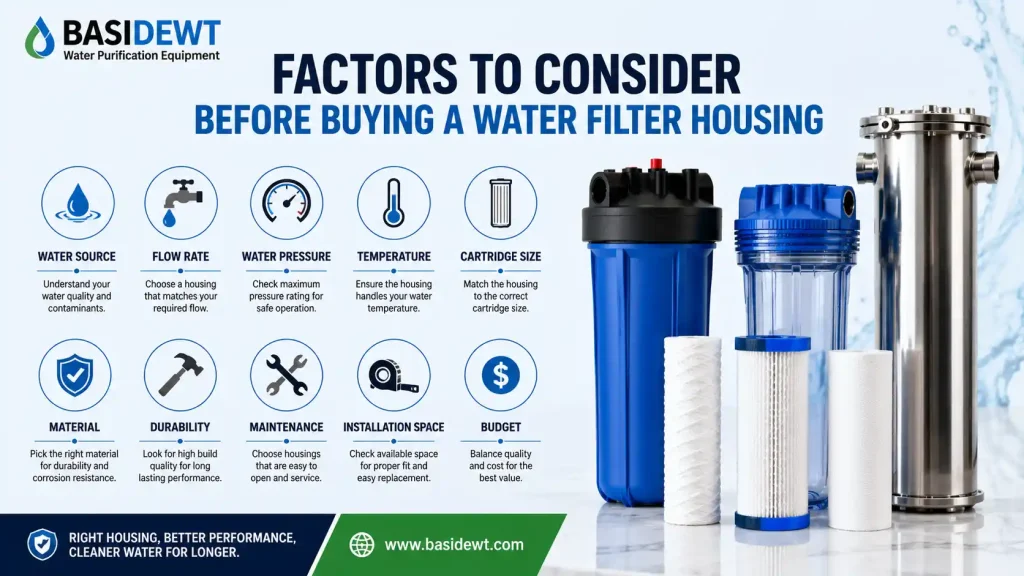
Before you compare brands or prices, you need to understand your own application. These ten factors shape every good buying decision.
Water Source
Well water, municipal water, and surface water each carry different contaminant loads. Well water often has higher sediment and iron content, so it usually needs a housing built for heavier particulate loads. Municipal water tends to be cleaner but may still contain chlorine byproducts or fine sediment from aging pipes.
Knowing your water source helps you decide on micron rating and cartridge type before you even look at housing size.
Residential vs Commercial vs Industrial Use
A single-family home rarely needs the same housing as a restaurant or a manufacturing plant. Residential setups usually run on standard or Big Blue housings. Commercial buildings often need higher flow capacity and more frequent servicing access. Industrial facilities may require multi-cartridge housings or bag filter systems built for continuous, high-volume operation.
If you are sourcing for an industrial site, our detailed breakdown of industrial water filter housing applications and selection criteria covers this in depth.
Flow Rate
Flow rate, measured in gallons per minute (GPM) or liters per minute (LPM), tells you how much water the housing must handle without a major pressure drop. A household with three bathrooms running simultaneously needs a higher flow capacity than a single-bathroom apartment.
Undersized housings restrict flow and frustrate users. Oversized housings waste money and space. Matching flow rate to actual demand is one of the most important steps in the entire buying process.
Water Pressure
Every housing carries a maximum pressure rating, typically between 100 and 150 psi for standard residential units. Industrial housings can rate much higher. Before buying, test your incoming water pressure and compare it against the housing’s rated maximum, with a safety margin included.
Running a housing near its pressure limit for long periods accelerates wear on seals and O-rings.
Operating Temperature
Hot water lines, outdoor installations in hot climates, and certain industrial processes all involve elevated temperatures. Standard plastic housings usually tolerate up to around 100°F to 125°F. If your application involves higher temperatures, stainless steel or specially rated polymer housings become necessary.
Cartridge Size
Cartridge diameter and length must match the housing exactly. Standard cartridges typically measure 2.5 inches in diameter, while Big Blue cartridges measure 4.5 inches. Length options commonly include 10, 20, and 30 inches.
Mismatched cartridges cause water to bypass the filter media entirely, which defeats the purpose of filtration.
Housing Size
Housing size and cartridge size go hand in hand, but housing size also affects flow capacity and dirt-holding volume. Larger housings hold more sediment before requiring a cartridge change, which reduces maintenance frequency.
Housing Material
Plastic, stainless steel, and reinforced polymer housings each perform differently under pressure, heat, and chemical exposure. We cover this in detail in the material comparison section below.
Installation Space
Available space under a sink, in a utility room, or along a pipeline determines which housing size and configuration are physically possible. Measure your installation area, including clearance needed for cartridge changes, before finalizing your choice.
Maintenance Requirements
Some housings use simple twist-off caps. Others require wrenches or specialized tools. If your facility has limited staff time for maintenance, prioritize housings designed for quick, tool-free cartridge changes.
Understanding Different Water Filter Housing Sizes
Housing size is not just about physical dimensions. It directly affects flow rate, sediment capacity, and how often you need to replace cartridges.
Standard Housing
Standard housings typically use 2.5-inch diameter cartridges in 10-inch or 20-inch lengths. They work well for residential point-of-use applications, such as under-sink filtration or single-point treatment.
Big Blue Housing
Big Blue housings use 4.5-inch diameter cartridges, which roughly triples the surface area compared to standard cartridges. This translates into higher flow rates and longer intervals between cartridge changes. Big Blue housings are a popular choice for whole house filtration. Our guide on whole house water filter housing options explains how these systems handle full-home water demand.
High Flow Housing
High flow housings are built for applications where flow rate matters more than anything else, such as larger homes, small commercial buildings, or light industrial use. These housings typically support flow rates well above what standard or Big Blue housings can handle. If your facility needs consistent high-volume output, our article on high flow water filter housing benefits and applications walks through sizing calculations and real-world use cases.
Bag Filter Housing
Bag filter housings use fabric or mesh filter bags instead of rigid cartridges. They excel in industrial settings with heavy sediment loads, since bags can hold significantly more debris than cartridges before needing replacement. For facilities considering this option, our industrial bag filter housing product page shows the available configurations.
Choosing the Right Material
Material choice affects durability, chemical resistance, appearance, and cost. Here is a practical comparison to help you decide.
| Material | Durability | Corrosion Resistance | UV Resistance | Best Use Case | Relative Cost |
|---|---|---|---|---|---|
| Plastic (Polypropylene) | Moderate | Good | Poor unless UV-stabilized | Residential, light commercial | Low |
| Stainless Steel | Excellent | Excellent | Excellent | Industrial, outdoor, high-pressure | High |
| Clear Housing | Moderate | Good | Poor, prone to yellowing | Visual monitoring of cartridge condition | Low to Moderate |
| Blue Housing (Opaque) | Moderate | Good | Better than clear | Indoor and shaded outdoor installations | Low to Moderate |
Plastic Housing
Plastic housings, usually made from reinforced polypropylene, offer an affordable and lightweight option for most residential and light commercial jobs. They handle typical household pressure ranges well but degrade faster under constant UV exposure or high temperatures.
Stainless Steel Housing
Stainless steel housings cost more upfront, but they last significantly longer in demanding environments. Industrial buyers, outdoor installations, and facilities dealing with high pressure or heat often choose stainless steel for its strength and corrosion resistance. For a deeper side-by-side comparison, see our article on plastic versus stainless steel water filter housings.
Clear Housing
Clear housings let you see the cartridge without opening the unit, which helps you track sediment buildup and know exactly when to schedule a replacement. However, clear plastic tends to degrade faster under direct sunlight, so it works best indoors or in shaded locations.
Blue Housing
Blue housings block more UV light than clear ones, extending their usable lifespan in semi-outdoor or garage installations. They sacrifice visual monitoring but gain durability. Our comparison of clear versus blue water filter housings breaks down which option fits different installation environments.
Choosing the Right Housing for Different Applications
Matching the housing to your specific application prevents costly mistakes. Here are practical scenarios across common use cases.
Whole House Systems
A family of four in a three-bathroom home typically needs a Big Blue or high flow housing to maintain consistent pressure across multiple fixtures. Undersizing here is the most common mistake homeowners make, since a housing that works fine for one faucet often struggles when the dishwasher, shower, and washing machine run together.
Well Water
Well water often carries sediment, iron, and sometimes bacteria, depending on the source. Housings paired with sediment pre-filters, and sometimes a secondary carbon or specialty cartridge, handle these conditions well. Stainless steel or heavy-duty polypropylene housings hold up better against the mineral content typical in well water.
Municipal Water
Municipal water usually needs less aggressive filtration, since treatment plants already remove most sediment and pathogens. Standard or Big Blue housings with carbon cartridges typically handle chlorine taste and odor reduction effectively.
Reverse Osmosis Pretreatment
RO systems perform best when pretreated water arrives free of sediment and chlorine, since both can damage RO membranes prematurely. A correctly sized pre-filter housing extends membrane life significantly and reduces how often the RO system needs servicing.
Industrial Water Treatment
Industrial buyers usually need higher flow capacity, higher pressure tolerance, and materials built for continuous duty. Multi-round housings or bag filter systems are common here, since they handle large volumes without frequent interruptions for cartridge changes.
Commercial Buildings
Office buildings, hotels, and restaurants need housings that balance flow capacity with manageable maintenance schedules. Facility managers often prioritize housings with quick-change designs to minimize downtime during service visits. Browsing our water filter housing category page can help narrow down commercial-grade options by size and flow rating.
Manufacturing Plants
Manufacturing facilities often deal with process water requirements that differ from potable water needs. These applications may call for higher-pressure stainless steel housings, sometimes paired with specialty cartridges suited to specific contaminants found in that facility’s water supply. Our water filter cartridge category page shows compatible cartridge options for various housing types.
Common Buying Mistakes
Even experienced buyers make errors when purchasing water filter housings. Here are the mistakes we see most often.
Ignoring flow rate demand. Buyers often size a housing based on pipe diameter alone, without calculating actual peak water demand.
Choosing material based on price alone. A cheaper plastic housing might fail sooner in outdoor or high-temperature conditions, costing more in replacements over time.
Overlooking pressure rating margins. Buying a housing rated exactly at your system’s pressure, with no safety buffer, increases the risk of premature failure.
Mismatching cartridge and housing dimensions. This is one of the most frequent installation errors, especially when buyers switch suppliers without checking exact measurements.
Underestimating maintenance access. Some installations place housings in locations too tight to allow easy cartridge replacement, which leads to skipped maintenance and reduced filtration performance.
Forgetting about future capacity needs. Homes and businesses grow. A housing sized only for today’s needs might become inadequate within a few years.
Expert Buying Tips
Start by measuring your actual water usage, not just your pipe size. Peak demand, not average demand, should guide your flow rate calculation.
Always add a safety margin to your pressure rating requirement. A 20 percent buffer above your typical operating pressure protects against pressure spikes.
Ask your supplier for the housing’s certified flow rate at your specific pressure range, since flow capacity often changes depending on inlet pressure.
If you are unsure about sizing calculations, Pentair’s guide on how to choose a home water filter offers useful sizing considerations based on flow rate and household size, which can serve as a helpful reference point.
Consider total cost of ownership rather than sticker price alone. A slightly more expensive housing that lasts twice as long, and needs fewer cartridge changes, usually wins on long-term value.
For OEM buyers and distributors sourcing at scale, request pressure test data and material certifications directly from the manufacturer before committing to a bulk order.
Final Thoughts
Choosing the right water filter housing comes down to matching real-world conditions with the right specifications. Water source, flow rate, pressure, material, and installation space all play a role in the final decision.
Take the time to measure your actual demand before comparing products. A housing that fits your specific application will perform better, last longer, and cost less over its lifetime than one chosen on price or appearance alone.
If you are ready to explore options suited to your application, our water filter housing product range includes standard, Big Blue, and high flow configurations, along with whole house systems built for residential and light commercial use. For high-capacity needs, our high flow cartridge filter housing is worth reviewing as well.
RELATED POSTS
Types of RO Water Systems: Which One Is Right for Your Needs?
how much does a home water treatment system cost
Commercial Water Fed Pole Systems: Choosing Equipment for Professional Cleaning
What is the Difference Between Tap & Brackish Water Membranes?
Whole House Water Softening System: The Complete Buyer’s Guide for Homeowners and Facility Managers