BasideWT- Whole Home Water Filtration System & Replacement


Best Spotless Water System for Car Wash: Complete 2026 Guide
Every car owner knows the frustration. You wash the car carefully. It looks perfect while wet. Then it dries — and white mineral spots appear all over the paint and glass.
A spotless water system solves this at the root. Instead of fighting spots after they form, it removes the minerals from your water before they ever touch the vehicle. No spots form. No drying is needed.
But choosing the right system takes more than picking the most popular brand. Your water hardness, your washing volume, and your budget all shape which system actually works for you.
Quick Answer
A spotless water system removes dissolved minerals from tap water using deionization (DI) resin, reverse osmosis (RO), or a combination of both. The purified water — with a TDS reading near 0 ppm — dries on vehicle surfaces without leaving any spots or residue. Home users with soft water do well with DI-only systems. Hard water areas above 300 ppm TDS benefit most from combined RO + DI configurations.
What Is a Spotless Water System?
The Core Definition
A spotless water system purifies tap water by removing dissolved minerals and ionic contaminants. The result is water so pure it dries without leaving marks on paint, glass, or trim. Most systems connect directly to a standard garden hose. No complex installation is required for residential units.
Professional and commercial versions connect to fixed plumbing and handle much higher daily water volumes. All versions share the same goal: output water with a TDS near zero.
What It Is Not
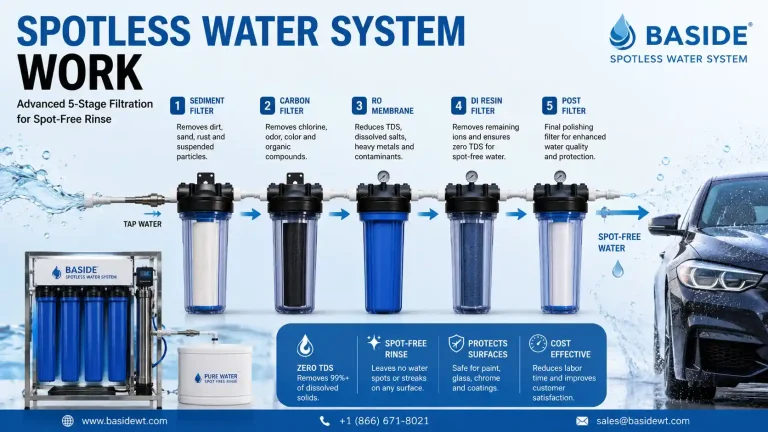
Many buyers confuse spotless water systems with water softeners. Understanding how a spotless water system works at the chemistry level makes this clear.
A water softener swaps calcium and magnesium ions for sodium ions. Sodium is still a dissolved solid. Softened water still spots when it dries. A spotless water system removes all ions — leaving water with nothing left to deposit on surfaces.
Where These Systems Are Used
- Home car washing
- Mobile and fixed-location auto detailing
- Commercial car wash tunnels
- Professional window cleaning with waterfed poles
- Solar panel maintenance
- Marine vessel rinsing
Why Water Spots Happen
The Chemistry Behind Spotting
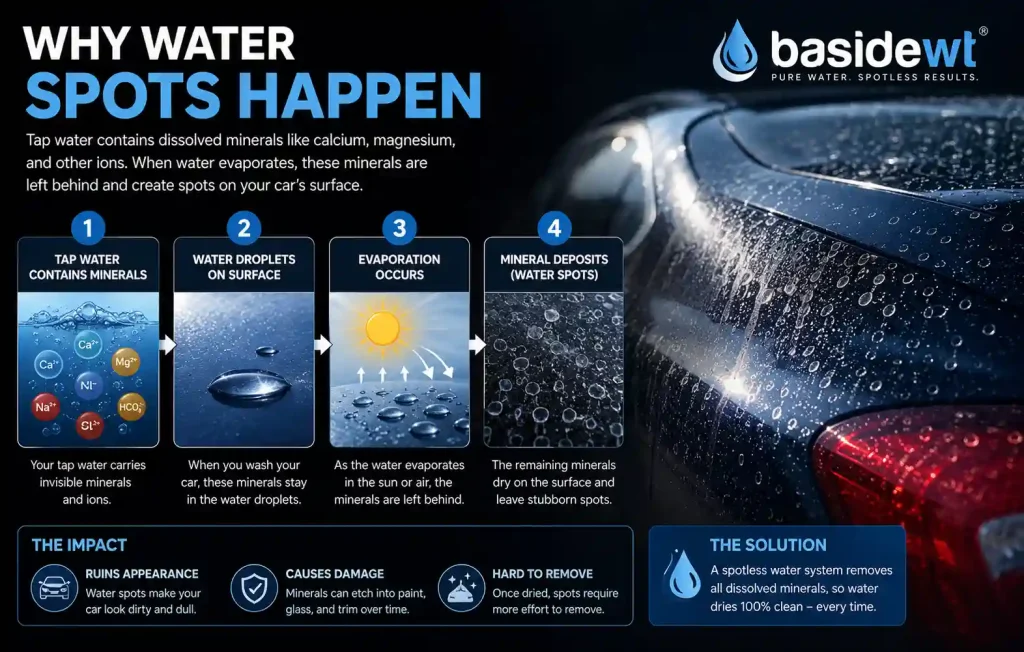
Tap water carries dissolved calcium, magnesium, sodium, and other minerals. While the water is liquid, these minerals are invisible. When water evaporates, the minerals stay behind and bond to the surface as white, chalky deposits.
Higher mineral concentration means worse spotting. Source water above 300 ppm TDS creates severe spotting on dark vehicles, especially in direct sunlight.
Why Dark Vehicles Show It Most
Black, dark blue, and grey paint amplifies spotting dramatically. Light-colored vehicles hide mild spotting reasonably well. For dark paint — and especially for ceramic-coated or recently polished vehicles — even low-level mineral deposits are clearly visible and damage the finish impression immediately.
Long-Term Surface Damage
Repeated mineral deposition does more than look bad. Calcium deposits etched into clear coat by heat and UV exposure create pitting that detailing products can soften but rarely reverse fully. Preventing spots from forming protects the surface far more effectively than removing them later.
How Spotless Water Systems Work
Deionization: The Core Process
Deionization (DI) passes water through mixed-bed ion exchange resin. Cation resin captures positively charged minerals like calcium and magnesium. Anion resin captures negatively charged ions like chloride and sulfate.
Both types release water-forming ions instead — hydrogen (H⁺) and hydroxide (OH⁻) — which combine into pure water molecules. Nothing is left to spot the surface when the water dries.
What Happens Inside the Tank
Water enters through the top of the resin tank. It flows slowly through millions of resin beads, each carrying active exchange sites. Ions transfer from the water to the resin bead surface.
Purified water exits from the bottom and travels to your hose or spray nozzle. The whole process happens passively — no electricity, no pump, no chemicals.
Flow Rate and Contact Time
Contact time between water and resin determines output purity. Higher flow rates reduce contact time. Ions pass through without being fully captured. TDS in the output rises.
Most residential DI systems work best at 1 to 3 gallons per minute (GPM). Commercial systems handle higher flows through larger resin volumes. Never exceed the manufacturer’s rated flow rate.
RO vs DI vs RO + DI Explained
Technology Comparison Table
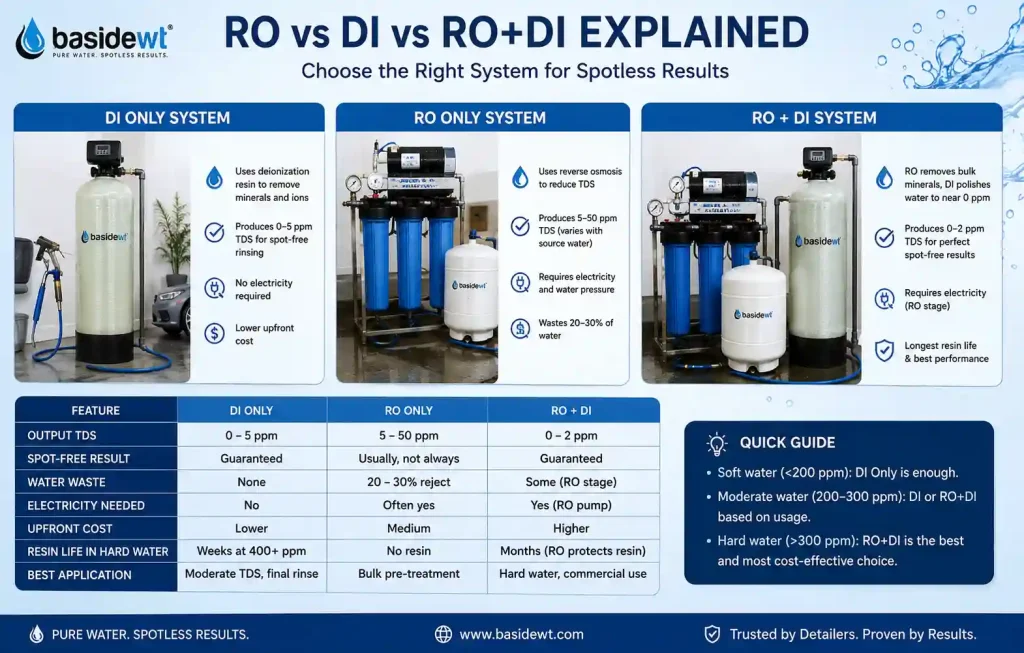
| Factor | DI Only | RO Only | RO + DI |
|---|---|---|---|
| Output TDS | 0–5 ppm | 5–50 ppm | 0–2 ppm |
| Spot-Free Result | Guaranteed | Usually, not always | Guaranteed |
| Water Waste | None | 20–30% reject | Some (RO stage) |
| Electricity Needed | No | Often yes | Yes (RO pump) |
| Upfront Cost | Lower | Medium | Higher |
| Resin Life in Hard Water | Weeks at 400+ ppm | No resin | Months (RO protects resin) |
| Best Application | Moderate TDS, final rinse | Bulk pre-treatment | Hard water, commercial |
When DI Alone Works
DI-only systems perform excellently in source water under 200 ppm TDS. Resin lasts long enough to keep running costs manageable. Home users and low-volume detailers in soft water regions rarely need anything more.
The key advantage: no electricity, no water waste, no storage tank. Just connect to the hose and go.
When You Need RO Pre-Treatment
Above 300 ppm source TDS, DI resin exhausts very quickly. At 400 ppm, a 1-cubic-foot resin bed may produce only 400 to 500 gallons before exhaustion. For a professional detailer using 20 gallons per vehicle at 30 vehicles per week, that is one resin change per week.
Adding RO pre-treatment reduces the water entering the DI stage to 20–40 ppm. Resin life extends by a factor of 10 or more. The detailed RO vs DI comparison guide covers the economics across different water conditions.
Understanding TDS
What TDS Means in Practice
TDS stands for Total Dissolved Solids. It measures all dissolved substances in water — calcium, magnesium, sodium, chloride, sulfate, and others — combined into a single ppm (parts per million) reading.
Pure water reads 0 ppm. Average tap water reads 100 to 400 ppm. Hard water regions regularly exceed 400 to 600 ppm.
TDS and Spotting Risk
| TDS Level | Spotting Risk | Practical Result |
|---|---|---|
| 0–5 ppm | None | Spot-free in any condition |
| 6–15 ppm | Very low | Safe in shade; minor risk in direct sun |
| 16–30 ppm | Moderate | Visible spotting on dark paint in sunlight |
| 31–100 ppm | High | Spotting without hand drying |
| 100+ ppm | Severe | Heavy spotting — standard tap water territory |
How to Test Your Water
Buy a TDS meter before choosing any system. Basic models cost under $20. Dip the probe into your tap water and read the result in seconds. That number determines your technology choice, resin volume, and estimated running costs.
Test at different times of day and across different seasons. Water hardness can shift as municipal supply sources change, particularly during summer months.
Key Components
The Resin Tank
The resin tank is the core of any spotless water system. It houses the mixed-bed ion exchange resin and directs water flow through the media. Quality tanks use UV-stabilized polypropylene that resists pressure variation and chemical exposure.
Resin grade matters enormously. Nuclear-grade mixed-bed resin delivers lower output TDS, higher capacity per cubic foot, and longer service life than standard alternatives.
The TDS Meter
Never operate a spotless water system without a TDS meter. Output TDS rises gradually as resin approaches exhaustion. You cannot see or smell this change. Only the meter tells you when purity has dropped below acceptable levels.
A good meter costs $15 to $30 and lasts for years. Check output TDS before every wash session. Replace resin when the reading consistently exceeds 10 ppm.
The Bypass Valve
A bypass valve routes tap water during the main wash and switches to purified water for the final rinse only. Using DI water for the entire wash wastes 60–80% of resin capacity on tasks where tap water works just as well.
With a bypass valve, you extend resin life dramatically. For a home user washing one car per week, this can mean replacing resin twice per year instead of ten or more times.
Pre-Filters
Two pre-filters protect the resin from premature damage:
- Sediment filter (5–20 micron): Removes sand, rust, and particulate matter.
- Carbon block filter: Removes chlorine from municipal water. Chlorine degrades resin polymer chains over time. Without carbon protection, resin life can shorten by 30–50% in chlorinated supply.
Benefits by Use Case
Home Car Washing
Home users gain the most visible daily benefit. Cars air-dry completely clean. No towel-drying means no swirl marks from microfiber contact. Dark-colored vehicles that were previously impossible to dry without spotting now look flawless every wash.
Long-term, surfaces stay cleaner. Scale buildup on glass is prevented rather than periodically removed. Washing becomes faster overall because the final rinse is the last step.
For home users, explore the portable spotless water system range built specifically for garden hose connection and single-vehicle frequency.
Professional Detailing
Professional detailers need reliable zero-TDS output across an entire working day. Inconsistent water quality causes inconsistent results — which damages reputation faster than anything else.
For mobile detailers, the system must fit in a van, connect quickly at any outdoor tap, and produce consistent output regardless of location. Bypass valve functionality is essential to preserve resin across a full day of multiple washes.
Commercial Car Wash Facilities
Commercial operations need systems that match daily throughput. Using a domestic DI tank in a tunnel wash would require daily resin changes and still fail to keep pace with volume.
The right approach:
- Size an RO system to produce 20–30% more than peak daily purified water demand.
- Store RO output in a holding tank.
- Run DI polishing on the spot-free final rinse arch only.
- Monitor DI output TDS on a scheduled maintenance basis.
Explore commercial spot-free car wash systems designed for tunnel and bay-wash installation.
Window Cleaning
Waterfed pole window cleaning uses DI water to scrub and rinse glass simultaneously. No squeegee is needed. No drying step is required. Output water purity determines whether glass dries perfectly clear or shows faint streaking.
Lower flow rates in window cleaning — typically under 1.5 GPM — mean resin lasts considerably longer than in car washing. A mid-capacity portable DI system suits most professional window cleaners. See the full car and window cleaning system range for waterfed pole-compatible configurations.
Buying Guide
Pros and Cons of Each System Type
| System Type | Pros | Cons |
|---|---|---|
| DI Only | No electricity, no waste water, simple setup | Expensive per gallon in hard water |
| RO Only | Good volume output, broad contaminant removal | Rarely reaches 0 ppm, requires pump and tank |
| RO + DI | Guaranteed 0 ppm, resin lasts 10× longer | Higher upfront cost, more components to maintain |
| Portable DI | Fully mobile, instant connection | Limited capacity, resin changes more frequent |
| Fixed Commercial | High daily volume, consistent output | Requires plumbing, installation, and space |
The Buying Checklist
Before purchasing, confirm every item below:
- Source water TDS tested (know your exact input number)
- Weekly purified water volume calculated (vehicles × gallons per rinse)
- Technology match confirmed (DI only, or RO + DI for TDS above 300 ppm)
- Resin capacity sufficient for 30+ days between changes at your TDS level
- TDS meter included or available as accessory
- Bypass valve present on DI system
- Carbon pre-filter included for municipal chlorinated supply
- Sediment pre-filter included
- Flow rate rating at or above your intended hose connection speed
- Replacement resin readily available and priced
- Inlet/outlet fittings match your water supply standard
Sizing Your System
Match the system to your volume, not to your wishlist. A home user needs 2 to 10 gallons of purified water per vehicle for the final rinse. A mobile detailer processing 30 vehicles per week needs 600 to 900 gallons of pure water weekly.
Calculate your weekly volume. Choose a resin size that handles at least four weeks at your actual source TDS. Undersizing resin is the single most common — and most costly — configuration mistake buyers make.
For broader context on water treatment system costs and configuration, the complete 2026 water softener cost guide provides useful comparison benchmarks.
Cost Breakdown
Upfront Equipment Cost
| System Category | Typical Price Range |
|---|---|
| Portable DI Tank (home) | $150 – $600 |
| Professional Portable DI | $400 – $1,200 |
| Combined Portable RO + DI | $600 – $2,000 |
| Fixed Commercial RO System | $1,500 – $8,000+ |
| Fixed Commercial RO + DI | $2,500 – $15,000+ |
Running Cost Reality
Running costs surprise most first-time buyers. Resin replacement dominates the budget for DI-only systems in hard water regions.
At 400 ppm source TDS, a 1-cubic-foot resin bed produces roughly 400–500 gallons before exhaustion. Replacement resin costs $50–$100 per cubic foot. For a professional detailer processing 600 gallons of purified water per week, that means near-weekly resin changes without RO pre-treatment.
With RO pre-treatment bringing input to 30 ppm, the same resin volume lasts 12 to 16 weeks. Research published in water treatment literature — including studies accessible through Science Direct — confirms that sequential RO and ion exchange is standard industrial practice for minimizing resin consumption while maintaining output purity.
Cost Per Gallon Comparison
| Setup | Hard Water (400 ppm) | Moderate Water (150 ppm) |
|---|---|---|
| DI Only | $0.12 – $0.25 per gallon | $0.03 – $0.06 per gallon |
| RO + DI | $0.02 – $0.05 per gallon | $0.01 – $0.03 per gallon |
These numbers make the economics of combined systems clear in hard water regions.
Maintenance Requirements
Monthly Maintenance Checklist
- Check output TDS before every wash session
- Replace sediment pre-filter when pressure drop becomes noticeable
- Replace carbon pre-filter every 6 months (chlorinated municipal water)
- Inspect O-rings on housing caps and fittings
- Track total gallons processed since last resin change
- Flush storage tank (RO systems) if unused for more than 2 weeks
- Calibrate TDS meter against known standard solution every 3–6 months
- Clean TDS meter probe tips — mineral deposits cause false readings
When to Replace Resin
Replace DI resin when output TDS consistently reads above 10 ppm. Do not wait for spotting to appear before acting. By the time spots return, the system has already been operating on degraded output through multiple wash sessions.
Also replace resin if output water shows discoloration. Discoloration signals algae growth inside the resin bed — common when a system sits unused with moisture present for 60–90 days or more. In that situation, clean the housing before refilling with fresh resin.
RO Membrane Care
RO membranes last 1 to 3 years depending on source water quality and usage. Signs of membrane degradation include:
- Rising output TDS from the RO stage (above 50 ppm)
- Reduced daily production volume at the same pressure
- Unusual taste or odor in output water
Common Mistakes
Mistake 1: Skipping the TDS Test
Many buyers choose a system without ever testing their source water. They base the decision on price or brand recognition instead. Hard water buyers end up with undersized DI systems that exhaust in days. Soft water buyers overspend on RO + DI systems they do not need.
Five minutes with a basic TDS meter before purchase eliminates this mistake entirely.
Mistake 2: Using a Pressure Washer Through the DI Stage
Pressure washers output 5 to 8 GPM or more. DI resin at these flow rates cannot maintain adequate water contact time. Ions pass through without being captured. TDS rises immediately. Resin is consumed on improperly treated water.
The correct workflow:
- Pressure wash with tap water through the main and rinse stages.
- Switch to DI or RO + DI output — at low, controlled flow — for the final spot-free rinse only.
Mistake 3: No Carbon Pre-Filter on Municipal Water
Chlorine from municipal water treatment oxidizes and degrades resin polymer chains over time. Without carbon protection, resin life shortens by 30–50% compared to unchlorinated source water.
A carbon pre-filter cartridge costs $15–$30 and replaces every 6 months. Not including it costs far more in accelerated resin consumption.
Mistake 4: Ignoring Capacity Ratings’ TDS Assumptions
Manufacturers quote resin capacity at a standard TDS — often 200 ppm. If your source water is 400 ppm, actual capacity halves from that quoted figure. Always ask what TDS the quoted gallons-per-cartridge figure assumes.
Expert Recommendations
Expert Tips
- Always test source water TDS before buying any system.
- For source water under 200 ppm: DI-only with bypass valve works well.
- For source water 200–300 ppm: Evaluate your volume — light home use may stay DI-only; professional volume justifies RO + DI.
- For source water above 300 ppm: Combined RO + DI is strongly recommended regardless of volume.
- Use bypass valve to limit DI water to final rinse only — this single habit extends resin life by 60–80%.
- For window cleaning: DI-only suits most waterfed pole applications; flow rates are naturally lower, so resin lasts much longer.
- For commercial car washes: size your RO system 20–30% above peak daily demand to provide buffer capacity.
- Never freeze a system with water in the resin tank — frozen resin suffers permanent capacity damage.
Home User Recommendation
Choose a quality portable DI tank with a bypass valve, TDS meter, and sediment and carbon pre-filters. Focus on resin grade — nuclear-grade mixed-bed resin outperforms standard-grade alternatives in output purity and capacity per cubic foot.
Professional Detailer Recommendation
Test your source water first. In moderate hardness areas, a 2-cubic-foot professional DI system handles a full working week between resin changes. In hard water regions above 300 ppm, combined RO + DI pays for its higher cost in resin savings within the first two months.
Commercial Operator Recommendation
Commission a full water test including TDS, pH, and iron content. Use these figures to size an RO system matched to daily production demand. Install DI polishing only on the spot-free rinse arch. Monitor TDS output on a weekly schedule and build resin replacement into your maintenance calendar rather than reacting to customer complaints.
For a comprehensive overview of spotless water systems across all configurations, the complete spotless water system guide covers product selection criteria, pre-treatment requirements, and maintenance scheduling in full detail. Commercial buyers can also review the full water filtration system range for industrial-scale configuration options.
Key Takeaways
- A spotless water system removes dissolved minerals to produce 0 ppm TDS output that dries without spots.
- DI-only systems suit soft to moderate water (under 200 ppm) and home or low-volume professional use.
- Combined RO + DI is the right choice for hard water regions above 300 ppm TDS and for commercial volume.
- Always test source water TDS before choosing a system.
- A bypass valve is essential — it extends resin life by 60–80% by limiting pure water to the final rinse only.
- Never connect a DI system directly to a pressure washer.
- Monitor output TDS before every wash session and replace resin when it exceeds 10 ppm.
FAQs
Does source water temperature affect spotless water system performance?
Yes. Water temperature can influence flow rate, resin efficiency, and TDS readings. Most modern spotless water systems operate effectively across a wide temperature range, but extremely cold water may slightly reduce flow and increase contact time requirements within the resin bed.
Can a spotless water system remove rust stains and existing mineral deposits?
No. A spotless water system prevents new spots from forming by removing dissolved minerals before rinsing. Existing water spots, rust stains, or mineral buildup must be removed using appropriate cleaning products before applying a final DI water rinse.
How much water does a home car wash use with a spotless water system?
A typical home car wash uses between 15 and 40 gallons of water depending on vehicle size and washing method. Using DI water only during the final rinse significantly reduces resin consumption while still delivering spot-free results.
Can spotless water systems be used for motorcycle and RV cleaning?
Yes. Spotless water systems are highly effective for motorcycles, RVs, boats, trailers, and other vehicles where water spots can be difficult to remove from painted surfaces, chrome, glass, and plastic components.
What are the signs that DI resin is nearing exhaustion?
The most reliable indicator is a rising TDS reading. Other signs include reduced spot-free performance, visible mineral residue after drying, and shorter intervals between resin replacements. Regular TDS monitoring helps identify resin exhaustion before cleaning quality declines.
Is a bypass valve necessary on a spotless water system?
While not mandatory, a bypass valve is strongly recommended. It allows users to switch between tap water and purified water during different stages of cleaning, reducing resin consumption and lowering operating costs without affecting final rinse quality.
Conclusion
Choosing the best spotless water system for car washing starts with one number: your source water TDS. Everything else — system type, resin volume, whether you need RO pre-treatment, and what the system will actually cost over two years — flows directly from that figure.
Home users in moderate hardness water get excellent results from a quality portable DI tank. Hard water buyers and professionals working at volume need combined RO + DI to keep running costs manageable. Commercial operators need properly sized RO production with DI polishing on the final rinse stage.
BASIDE Water Treatment manufactures spotless water systems, combined RO + DI configurations, and commercial spot-free car wash systems from its factory in Changsha, Hunan, China. OEM and ODM customization is available for international distributors and commercial buyers.
RELATED POSTS
Water Filter Housing Materials: Plastic vs Stainless Steel – Which Is Better?
How To Filter Arsenic From Water?
RO Water System: Complete Guide to Types, Benefits, Installation & Maintenance
UV Intensity in Water Sterilization: How It Affects Performance
What Is a Water Filter Housing? Complete Guide for Beginners