BasideWT- Whole Home Water Filtration System & Replacement

Common RO Water System Problems & How to Fix Them
Common RO water system problems usually show up as one of a few familiar signs: slow flow, odd taste, a leak under the sink, or a tank that never seems to fill. If you have noticed any of these, you are not alone. Most reverse osmosis units run into at least one hiccup during their lifetime, and almost every issue has a simple, traceable cause.
This guide walks through the problems homeowners, commercial buyers, and facility managers report most often. It also explains what usually causes them and how to fix them without guesswork. If you want the bigger picture first, our complete RO water system guide covers types, benefits, and setup in detail. This article focuses purely on troubleshooting.
Common RO Water System Problems: A Quick Overview
Before diving into causes and fixes, it helps to see the full picture. Most complaints fall into one of these categories:
- Reduced water pressure at the faucet
- Slow filling of the storage tank
- Unusual taste, smell, or cloudiness in the water
- Water leaking from fittings, filters, or the membrane housing
- Continuous water running to the drain
- Unexpected noise during operation
- Poor TDS reduction compared to normal
- Fouled or scaled membranes
- Clogged pre-filters restricting flow
Each of these symptoms points to a specific root cause. Understanding that connection is the fastest way to solve the problem correctly, rather than replacing parts at random.
Why RO Water Systems Develop Problems
Reverse osmosis systems are mechanically simple, but they still depend on consistent conditions to perform well. When those conditions change, problems follow. Several factors are usually behind most RO system troubles.
Poor feed water quality is one of the biggest culprits. High sediment, chlorine, or hardness levels put extra strain on filters and membranes. Incorrect installation also causes ongoing issues, since kinked tubing, poor fittings, or wrong pressure settings create problems from day one. Meanwhile, a lack of routine maintenance allows filters to clog and membranes to foul gradually, until performance drops noticeably.
Worn components play a role too. O-rings, valves, and check valves degrade over time, even with proper care. Finally, incorrect operating pressure, whether too high or too low, affects both water quality and flow rate directly.
The table below summarizes these common root causes and their typical effects.
| Root Cause | Typical Effect on the System |
|---|---|
| Poor feed water quality | Faster filter clogging, membrane fouling |
| Incorrect installation | Leaks, pressure loss, inconsistent flow |
| Lack of maintenance | Reduced TDS rejection, slow production |
| Worn components | Leaks, noise, pressure fluctuations |
| Incorrect operating pressure | Poor water quality, low output |
Recognizing which of these applies to your situation makes troubleshooting far more efficient.
Most Common RO Water System Problems
Let’s look closely at the individual issues that tend to appear most frequently in both residential and commercial RO water system troubleshooting.
Low Water Pressure
Low water pressure at the faucet is one of the most reported complaints. It usually stems from a waterlogged storage tank, a clogged pre-filter, or insufficient incoming supply pressure. Because RO membranes rely on adequate pressure to push water through effectively, even a small drop can noticeably slow output.
A waterlogged tank happens when the internal air bladder loses its charge, so the tank fills with water but can no longer push it out with force. This is often mistaken for a membrane problem, even though the fix is simple. Checking the air pre-charge first can save time before assuming a bigger part has failed.
Slow Water Production
Closely related to low pressure, slow production often points to a fouled RO membrane or exhausted pre-filters. Cold feed water temperature can also slow the process, since membranes work less efficiently in cooler conditions.
Seasonal changes explain many slow-production complaints that homeowners assume are equipment failures. As water temperature drops in winter, permeate flow naturally decreases, even in a fully functional system. Comparing current output against the manufacturer’s rated flow at standard conditions helps determine whether the drop is normal or a sign of a genuine fault.
Bad Taste or Odor
An unpleasant taste or smell almost always traces back to exhausted carbon filters or bacterial growth inside the tank or tubing. Since carbon filters remove chlorine and organic compounds, once they reach capacity, contaminants pass through untreated.
Water Leaks
Leaks typically appear at fitting connections, the membrane housing, or the storage tank valve. Worn O-rings, over-tightened fittings, or cracked housings are common culprits. Even a small leak should be addressed quickly, since it can damage cabinetry and indicates a seal failure elsewhere in the RO system.
Push-to-connect fittings are especially prone to leaking if the tubing was cut at an angle or not inserted fully during installation. Reinserting the tubing squarely and firmly often resolves the issue without replacing the fitting itself. If a leak persists after reseating the tubing, the fitting or O-ring likely needs replacement.
Continuous Drain Water
If water keeps flowing to the drain even when the tank is full, the automatic shutoff valve (ASO) has likely failed. This wastes water continuously and should be corrected as soon as it’s noticed, both for efficiency and cost reasons.
In commercial settings, a failed shutoff valve can waste a significant volume of water over just a few days, which adds unnecessary cost to operations. Facility managers should treat this symptom as a priority repair rather than a minor inconvenience.
Noisy System
A humming, hissing, or gurgling sound during operation is often normal, particularly during flushing cycles. However, a loud or unusual noise can indicate a failing check valve, trapped air, or a pressure imbalance that needs attention.
Low TDS Reduction
When total dissolved solids (TDS) levels rise unexpectedly in the treated water, it usually signals a worn-out or damaged membrane. Membranes lose efficiency gradually, so declining TDS rejection is a natural part of their service life.
Membrane Fouling
Membrane fouling happens when minerals, organic matter, or biological growth accumulate on the membrane surface. This restricts water flow and reduces purification efficiency, often making the system work harder for less output.
Clogged Pre-Filters
Pre-filters trap sediment, rust, and larger particles before water reaches the membrane. Once they become saturated, water flow slows dramatically, and the membrane becomes more vulnerable to fouling since it now handles more particulate load.
How to Troubleshoot Each Problem
Once you have identified the symptom, troubleshooting becomes far more targeted. Below is a practical breakdown of what to check for each common issue.
| Problem | First Thing to Check | Likely Fix |
|---|---|---|
| Low water pressure | Tank air pre-charge, feed pressure | Recharge tank or adjust pressure |
| Slow production | Pre-filter condition, membrane age | Replace filters or membrane |
| Bad taste or odor | Carbon filter age, tank cleanliness | Replace carbon filter, sanitize tank |
| Water leaks | Fittings, O-rings, housing cracks | Tighten, replace O-rings, or replace housing |
| Continuous drain flow | Automatic shutoff valve | Replace ASO valve |
| Noisy operation | Check valve, air in lines | Replace check valve, bleed air |
| Low TDS reduction | Membrane integrity | Test and replace membrane |
| Membrane fouling | Feed water quality, pre-filtration | Clean or replace membrane, improve pre-treatment |
| Clogged pre-filters | Filter change schedule | Replace filters promptly |
For pressure-related issues, always start with the storage tank. A properly pressurized tank, typically around 6 to 8 psi when empty, is essential for consistent flow. If pressure remains low after adjusting the tank, inspect the feed water supply line for restrictions.
For taste, odor, or TDS problems, testing the water with a TDS meter gives an immediate, measurable answer. A significant jump in TDS readings compared to baseline levels usually confirms a membrane issue rather than a filter problem.
Leaks are often easiest to trace visually. Run the system, then check each connection point systematically, starting from the feed valve and working toward the faucet. This step-by-step approach avoids unnecessary part replacements.
How to Prevent Future RO Water System Problems
Prevention is always more cost-effective than repair. While our dedicated maintenance guide covers scheduling in depth, a few preventive habits directly reduce the frequency of common problems.
Monitoring feed water quality helps you anticipate strain on filters and membranes before it becomes visible. Checking pressure settings periodically also prevents both underperformance and premature component wear. Additionally, keeping an eye on water flow and taste gives early warning signs, often before a full failure occurs.
Since correct setup reduces the risk of leaks and pressure problems from the start, following proper installation practices matters just as much as ongoing care. Our installation guide walks through the process for both residential and commercial use.
When Should You Replace Components?
Knowing when to replace parts prevents small issues from becoming bigger, more expensive ones. Sediment and carbon pre-filters generally need replacement every six to twelve months, depending on feed water quality. RO membranes typically last two to three years, though heavy usage or poor feed water can shorten that lifespan considerably.
O-rings and seals should be inspected during every filter change and replaced at the first sign of wear, cracking, or leaking. Valves, including the automatic shutoff valve and check valve, often last several years but should be replaced immediately once they show signs of failure, such as continuous drain flow or unusual noise.
Fittings rarely need replacement unless damaged or corroded, but they should always be checked whenever leaks appear nearby. Waiting too long to replace worn components tends to accelerate wear on other parts of the reverse osmosis system, so timely action pays off.
Expert Tips for Reliable RO System Performance
For homeowners, consistency matters most. Replacing filters on schedule and testing water quality periodically prevents the majority of common issues before they start.
Commercial RO system owners face higher usage demands, so more frequent monitoring is essential. Facility managers should track flow rates and TDS readings regularly, since early detection prevents costly downtime in commercial or industrial settings.
For both residential and commercial users, choosing the right system from the start reduces long-term problems significantly. Our buying guide explains how to match system capacity and features to your specific needs, which minimizes the strain that leads to many of the issues covered here.
It’s also worth understanding how your reverse osmosis unit actually purifies water, since that knowledge makes troubleshooting far more intuitive. Our step-by-step explanation of the RO process breaks down each stage clearly.
Keeping a simple maintenance log also makes a noticeable difference over time. Recording filter change dates, TDS readings, and any repairs creates a clear history that makes future troubleshooting faster. When a problem does appear, that log often points directly to the likely cause, whether it’s an overdue filter or an aging membrane approaching the end of its service life.
Finally, avoid the temptation to ignore small symptoms. A slightly slower flow or a faint change in taste is often the earliest warning sign of a larger issue developing. Addressing these signs early, rather than waiting for a complete failure, keeps repair costs lower and extends the overall lifespan of the system.
According to the Water Quality Association, reverse osmosis systems are frequently paired with additional treatment stages, such as activated carbon and UV, to maximize contaminant removal and improve overall reliability. This layered approach is one reason well-maintained RO systems continue to perform consistently for years.
Conclusion
Common RO water system problems are rarely mysterious once you understand their causes. Low pressure, slow flow, bad taste, leaks, and membrane fouling almost always trace back to a specific, fixable issue, whether that’s feed water quality, a worn part, or a missed maintenance step.
By checking the right components in the right order, most issues can be resolved quickly and without unnecessary part replacements. If you would like to explore RO systems designed for long-term reliability, browse our full range of RO system solutions built for both home and commercial use.
For a broader understanding of how everything fits together, from system types to installation and maintenance, revisit our complete RO water system guide anytime you need a refresher.
RELATED POSTS
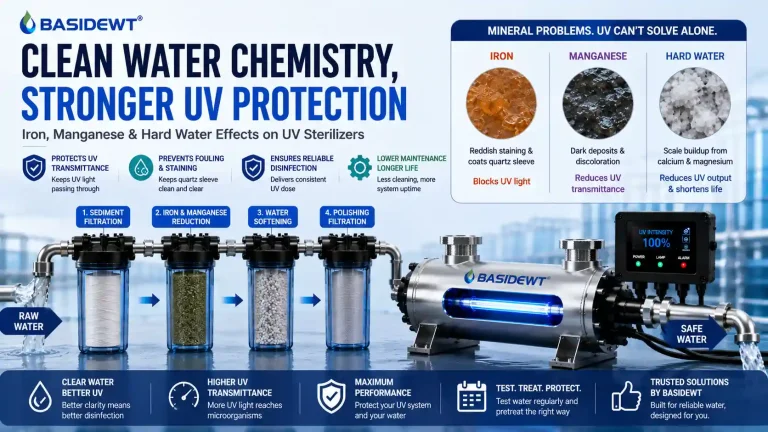
Iron, Manganese and Hard Water Effects on UV Sterilizers
Is Reverse Osmosis Water the Same as Distilled Water?
Water Softener Salt Guide: Types, Benefits & How to Choose the Right Salt
Water Filter System Problems: 10 Common Issues & Solutions
Big Blue 20 inch Water Filter-BasideWT