BasideWT- Whole Home Water Filtration System & Replacement



Pure Water Window Cleaning: Equipment, Process and Benefits
Clean windows should stay clean after they dry. That is the whole idea behind pure water window cleaning. Instead of relying on soap, squeegees, and constant wiping, this method uses purified water to rinse glass until it dries naturally, without streaks or spots.
This guide explains what pure water window cleaning actually involves. You will learn why plain tap water often causes problems, how the cleaning process works, what equipment is typically used, and where this method makes the biggest difference for both homes and businesses.
What “Pure Water” Means in Window Cleaning
“Pure water” is not just clean-looking water. It is water that has had almost all of its dissolved minerals removed.
Ordinary tap water contains small amounts of calcium, magnesium, and other minerals. These minerals are invisible while the water is still liquid. Once the water dries, though, the minerals stay behind on the glass.
Purified water avoids this problem. Because it carries almost no dissolved minerals, it does not leave a residue when it evaporates. This is the core reason pure water window cleaning produces such a clear finish.
Why Tap Water Leaves Marks on Glass
Tap water quality varies from one building to another. Some areas have relatively soft water. Others have harder water with a higher mineral content.
Either way, tap water almost always contains more dissolved solids than purified water. When it dries on glass, it can leave faint spots, streaks, or a hazy film. This is especially noticeable on large windows, glass balconies, and high-rise facades, where every mark is easy to see from a distance.
Traditional cleaning methods try to solve this by wiping the glass dry before the water has a chance to evaporate. Pure water window cleaning takes a different approach. It removes the minerals from the water itself, so drying no longer causes a problem.
How the Pure Water Cleaning Process Works
The pure water cleaning process follows a simple sequence, even though the equipment behind it can be more advanced.
First, ordinary tap water passes through a purification system. This step reduces the dissolved mineral content, producing water with very low total dissolved solids.
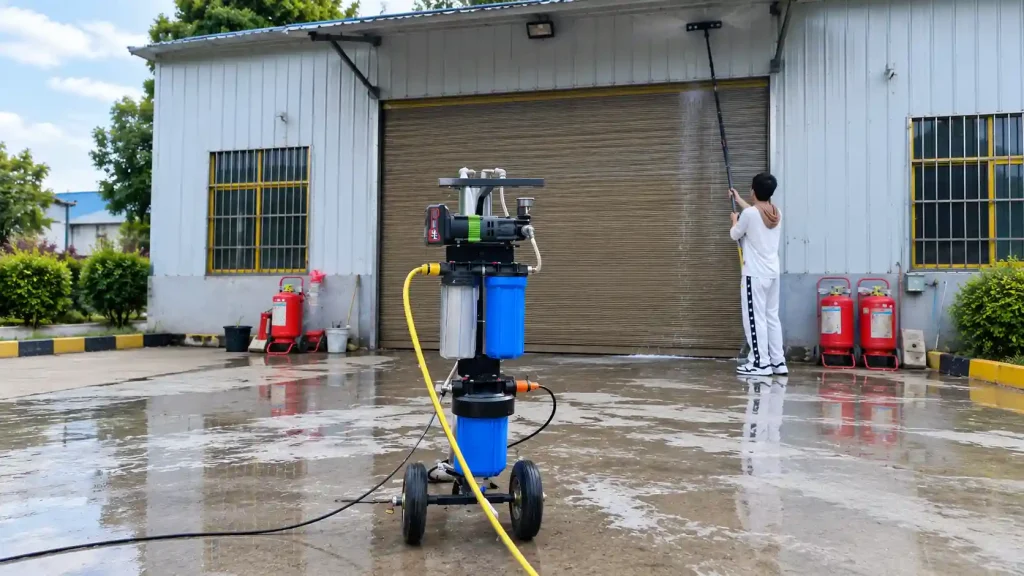
Next, the purified water travels through a hose to a pole fitted with a soft brush. The brush loosens dirt, dust, and grime from the glass surface. Purified water flows continuously through the brush, rinsing the loosened debris away as the operator works.
Finally, the window is left to air-dry. Because the rinse water carries almost no minerals, it dries without leaving spots. There is no need to squeegee or towel-dry the glass afterward.
This process forms the basis of the wider water fed pole window cleaning method, which many professional cleaners now use as their standard approach.
Equipment Used in Pure Water Window Cleaning
Several pieces of equipment work together during pure water window cleaning.
- A water purification unit, which reduces mineral content through reverse osmosis (RO), deionization (DI), or a combination of both.
- A water-fed pole, which extends the brush and hose to reach upper floors safely from ground level.
- A soft cleaning brush, which agitates the glass surface without scratching it.
- A hose and pump system, which carries purified water from the tank or purification unit to the brush.
- A TDS meter, which measures how many dissolved solids remain in the water.
Each part plays a specific role. If you want a deeper look at how these pieces fit together mechanically, this article on how a water fed pole works covers that topic in detail. For a broader view of the entire system, the complete water fed pole system guide walks through every stage from purification to final rinse.
The Role of Water Purification: RO and DI
Two purification methods are common in this field: reverse osmosis and deionization.
Reverse osmosis pushes water through a fine membrane. The membrane blocks most dissolved minerals and other impurities, letting purified water pass through.
Deionization uses resin beads instead. As water flows through the resin, it exchanges mineral ions for hydrogen and hydroxide ions, which effectively removes hardness from the water.
Many professional setups combine both methods, using RO first and DI second, to reach a very low mineral level. Businesses that want a ready-made option to explore can look at a spotless water system designed for this kind of purification.
Checking Water Purity with TDS
TDS stands for total dissolved solids. It measures how many minerals and other dissolved particles remain in a sample of water.
Lower TDS generally means fewer spots after the water dries. Most professional cleaners aim for a very low TDS reading before they start work, since even a small increase in mineral content can affect the final finish.
Checking TDS regularly helps confirm that a purification system is still working correctly. A simple handheld meter, such as a TDS meter for water testing, makes this check quick and reliable.
Where Pure Water Window Cleaning Works Best
This method suits a wide range of settings.
Residential properties benefit from a streak-free finish on everyday windows, patio doors, and conservatories. Commercial buildings benefit even more, since large glass facades are expensive to clean repeatedly and hard to reach safely without extended poles.
High-rise buildings, shopping centers, and office towers are common examples. In these settings, a full car and window cleaning system can support both vehicle washing and window cleaning tasks with the same purified water source, which helps cleaning businesses manage equipment more efficiently.
Benefits of Pure Water Window Cleaning
Pure water window cleaning offers several practical advantages.
- No streaks or spots. Low-mineral water dries clean without leaving marks.
- No chemicals needed. The process relies on water and gentle brushing, not detergents.
- Safer reach. Extendable poles let operators clean upper floors from the ground.
- Consistent results. Because the water quality stays steady, results stay steady too.
- Less repeat cleaning. Clean glass attracts less new dirt compared with glass that still carries a mineral film.
These benefits explain why many professional window cleaning businesses have shifted toward this method over the past two decades.
Practical Limitations and Common Mistakes
Pure water window cleaning is not without limits.
Purification systems need regular maintenance. Resin and membranes wear out over time, and if they are not replaced, TDS levels can creep upward without an obvious warning sign.
Very dirty or greasy glass may need an extra pass with the brush before rinsing, since heavy grime does not always loosen on the first attempt. Cold weather can also slow drying time, which sometimes allows dust to settle on the glass before it fully dries.
A common mistake is skipping TDS checks. Operators sometimes assume their purification system is working simply because the water looks clear. Clear water can still carry dissolved minerals, so a quick meter check remains the only reliable way to confirm purity.
Keeping Results Consistent
Consistency comes down to a few habits.
Test the water regularly with a TDS meter rather than relying on guesswork. Replace or service purification media on a fixed schedule instead of waiting for visible problems. Rinse each window fully before moving on, since a rushed rinse is one of the most common causes of uneven drying.
Cleaners who follow these habits tend to get the same clear result on every job, whether they are working on a single-story home or a large commercial building.
Conclusion
Pure water window cleaning works because it solves the root cause of streaks and spots: dissolved minerals in the water. By purifying the water first and then rinsing the glass thoroughly, this method delivers a clean finish without chemicals, squeegees, or repeated wiping.
Understanding the equipment, the purification process, and the role of TDS helps both homeowners and professional cleaners get more reliable results. For anyone who wants to understand the chemistry behind why untreated water behaves this way, this overview of how dissolved minerals affect water chemistry offers a clear, factual explanation.
RELATED POSTS
UF Membrane Troubleshooting: Low Flow, Fouling & Poor Performance

What Does a Water Filter Remove? Contaminants, Sediment & More
Water Fed Pole System Setup: A Complete Equipment and Connection Guide

Residential vs Commercial UF Membrane: What’s the Difference?
How To Change Whole House Water Filter?